


Titanium and aluminum solve very different engineering problems.
They are often compared in the same project because both can reduce weight compared with steel. In practice, they sit in different cost and performance ranges. Aluminum is easier to machine, easier to source, and far more economical for most housings, brackets, and general structural parts. Titanium costs much more, but it brings higher strength, better seawater and chloride resistance, and stronger performance where heat, fatigue, or biocompatibility matter.
This guide explains the real tradeoffs in titanium vs aluminum, so you can choose the right material for , weight control, corrosion resistance, and total manufacturing cost.
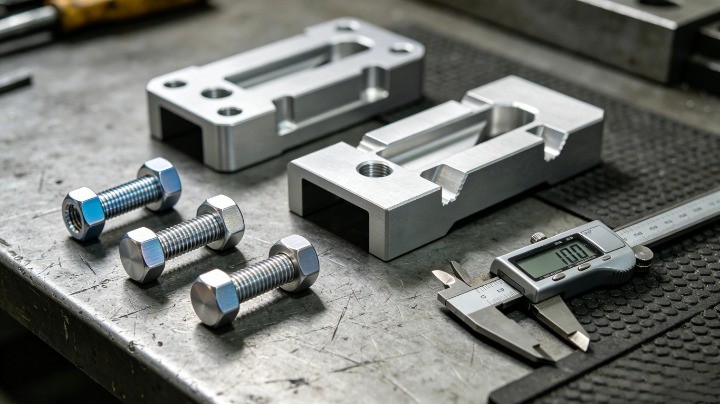
A Simple Rule of Thumb
Choose aluminum when cost, weight, machinability, and production speed matter most. Choose titanium when the part must survive higher loads, harsher environments, or stronger long-term performance demands. Hydro describes 6061 as a widely used structural aluminum alloy with good toughness, good seawater corrosion resistance, and adequate machinability in heat-treated tempers, while TIMET describes Ti-6Al-4V as a general-purpose titanium alloy with moderately high tensile strength, good fatigue strength, and useful properties retained up to about 350°C (660°F).
If the part is a housing, fixture, bracket, or other cost-sensitive machined component, aluminum is usually the more practical choice. If the part will see chloride exposure, extreme cyclic loading, body contact, or high temperature service, titanium often becomes the safer material even when the machining cost is much higher.
Titanium vs Aluminum at a Glance
| Factor | Titanium (Ti-6Al-4V as baseline) | Aluminum (6061/7075 family as baseline) |
|---|---|---|
| Density | About 4.42 g/cm³ | About 2.70 g/cm³ |
| Strength level | Much higher than common structural aluminum grades | Lower, but often sufficient for commercial parts |
| Strength-to-weight ratio | Excellent | Excellent, but usually below titanium |
| Corrosion resistance | Outstanding in seawater and many chloride environments | Good in atmosphere; depends more on alloy, finish, and environment |
| Thermal conductivity | Very low | Very high |
| CNC machinability | Difficult and slower | Easier and faster |
| Material and machining cost | High | Lower |
Titanium and aluminum are often compared as “lightweight metals,” but the practical choice usually comes down to four questions: how light the part must be, how much load it must carry, how aggressive the environment is, and how much machining cost the project can tolerate.
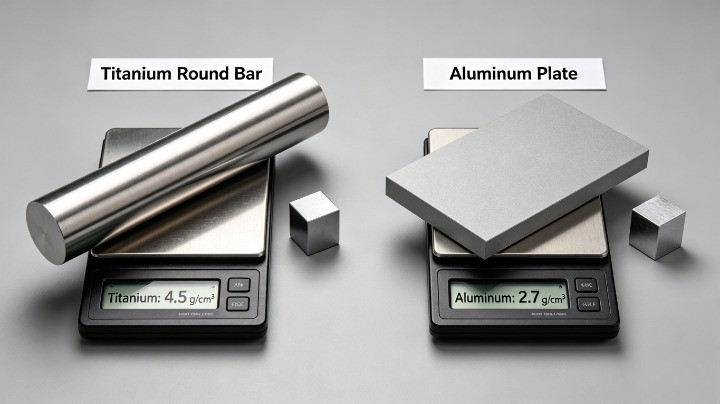
Which material is actually lighter?
Aluminum is lighter than titanium. This is one of the most common points of confusion in titanium vs aluminum comparisons.
NIST lists aluminum at about 2.6989 g/cm³, while TIMET lists Ti-6Al-4V at about 4.42 g/cm³. That means titanium is substantially heavier than aluminum part-for-part if both parts use the same geometry. If you need a broader reference point for common aluminum data, see .
This is why aluminum is usually the better choice when the main goal is to make the part physically lighter in a straightforward way. It is often a better fit for electronic housings, portable structures, lighter frames, and other parts where extreme loading is not the main constraint. Titanium can still create a lighter final assembly in some cases, but only when its higher strength allows the design to use less material.
Which material is stronger?
Titanium is generally much stronger than aluminum, and that is the main reason engineers pay the premium.
TIMET describes Ti-6Al-4V as a general-purpose titanium alloy with moderately high tensile strength and good fatigue strength. Its published data sheet shows room-temperature tensile strength around the 895 MPa level for annealed sheet and plate, with useful properties retained up to about 350°C (660°F). Hydro describes 6061 as a medium- to high-strength structural alloy, with minimum tensile strength values around 260 MPa in common T6 extrusion tempers.
That difference is why titanium is chosen for highly loaded , medical components, and severe-duty fasteners. Aluminum can still deliver excellent performance in many structural parts, but titanium gives more strength in the same general envelope when the load case is much more demanding.
What about strength-to-weight ratio?
Titanium usually wins on strength-to-weight ratio, even though aluminum is lighter.
This is the real reason titanium stays in the conversation. Aluminum is the lighter metal by density, but titanium carries much more load for its mass. That gives it an advantage in parts where both weight and strength matter at the same time.
In practical design terms:
-
choose aluminum when low mass and low cost matter more than maximum strength
-
choose titanium when the part must stay relatively light but still survive high stress or repeated fatigue loading
That difference matters most in aerospace parts, racing components, surgical implants, and pressure-loaded hardware.

Which one machines better in CNC production?
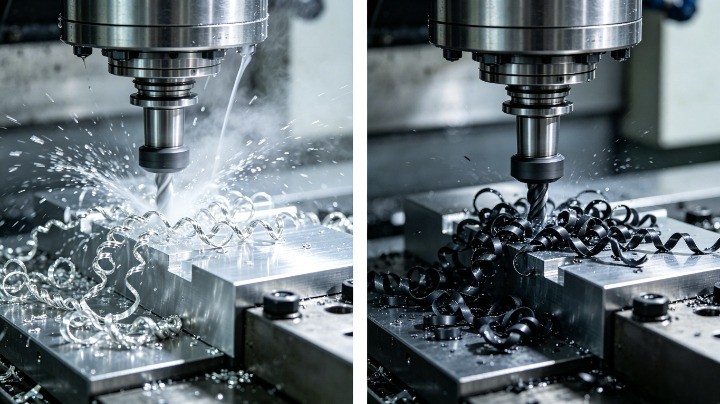
Aluminum is much easier to machine than titanium. This is one of the biggest reasons titanium parts cost so much more.
is usually more efficient in day-to-day production. Hydro notes that 6061 has adequate machinability in heat-treated tempers, although chip control can still require the right cutting approach. TIMET’s machining guidance for Ti-6Al-4V says titanium is a poor conductor of heat, that it permits rapid heat buildup at the cutting interface, and that it tends to react with the cutting tool by smearing, galling, and welding.
TIMET also notes that titanium’s low modulus can allow the workpiece to deflect more easily during machining. In practice, demands slower cutting conditions and tighter setup discipline.
That translates directly into shop-floor reality:
-
aluminum usually allows faster cycle times
-
aluminum is easier on tooling
-
aluminum is easier to fixture for general work
-
titanium needs slower feeds and stronger setup discipline
-
titanium usually consumes more tool life and more machine time
If the part geometry is simple and the environment is mild, that cost difference often makes aluminum the obvious choice.
Which material handles corrosion better?
Titanium has the stronger corrosion profile in aggressive environments, especially in seawater and chlorides.
Hydro states that 6061 has excellent corrosion resistance to atmospheric conditions and good corrosion resistance to seawater. TIMET states that Ti-6Al-4V is highly resistant to general corrosion in seawater, and its corrosion handbook says titanium has excellent resistance to corrosion by neutral chloride solutions and generally exhibits very low corrosion rates in chloride environments.
That difference matters in:
-
offshore and marine components
-
desalination and water-treatment equipment
-
chemical process hardware
-
long-life fasteners in corrosive environments
-
implantable medical devices
Aluminum still performs very well in many normal environments, and can improve its surface durability further. But when chloride resistance is one of the main design limits, titanium is usually the safer choice.
Which one handles heat and electricity better?
Aluminum is far better for heat transfer and electrical conduction. If the part needs to move heat, titanium is usually the wrong place to start.
The Aluminum Association lists typical aluminum sheet thermal conductivity in the range of about 113 to 234 W/m·K and typical electrical conductivity in the range of 16 to 36 MS/m. TIMET lists Ti-6Al-4V thermal conductivity at about 6.6 W/m·K at 20°C.
That is why aluminum stays dominant in:
-
heat sinks
-
battery cooling components
-
RF and electronics housings
-
conductive structural parts
-
lightweight thermal management hardware
Titanium is much better described as a structural material than a heat-transfer material. For enclosure-style applications, are often a much more practical route than titanium parts.
Which one is more cost-effective?
Aluminum is usually far more cost-effective once machining time is included. Titanium can justify its cost, but only when the application really needs its performance.
The cost difference does not come from raw material alone. It also comes from cycle time, tooling, workholding, inspection burden, and longer machining routes. Titanium’s poor thermal conductivity and tool reactivity make it a slower and more expensive metal to process. Aluminum is usually much easier to turn, mill, drill, and finish in production.
That means aluminum is usually the better value for:
-
high-volume machined parts
-
commercial housings and brackets
-
industrial automation hardware
-
general transportation components
-
cost-sensitive precision parts
Titanium usually makes sense only when the project would otherwise pay a larger penalty through failure risk, corrosion, fatigue, or performance limits. For a broader costing reference, see .
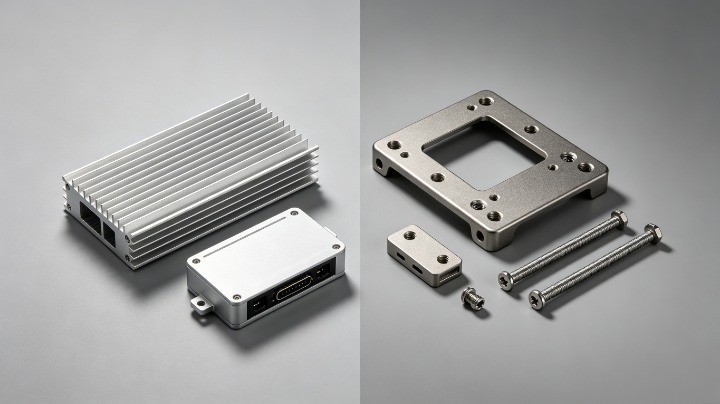
Typical applications
When titanium makes more sense
-
aerospace brackets and fasteners
-
orthopedic implants and surgical components
-
marine hardware in aggressive chloride exposure
-
pressure-loaded valves and fittings
-
parts close to heat or exhaust systems
TIMET lists airframes, jet engine and rocket components, pressure vessels, fasteners, and prosthetic implants among typical Ti-6Al-4V applications. In production, this also overlaps with for complex surgical or implant-related parts.
When aluminum makes more sense
-
industrial machine parts
-
sensor brackets and housings
-
consumer product enclosures
-
heat sinks and cooling plates
-
lightweight fixtures and structural components
Hydro lists transportation components, machinery and equipment, recreation products, and consumer durables among typical 6061 applications. For many of these parts, remain the more economical and scalable choice.
FAQ
Is titanium stronger than aluminum?
Yes. Titanium alloys such as Ti-6Al-4V generally deliver much higher strength than common structural aluminum alloys.
Is titanium lighter than aluminum?
No. Aluminum is lighter by density. Titanium is heavier, but it can still support lighter designs when its higher strength allows the part to use less material.
Why is titanium so much more expensive to machine?
Titanium builds heat at the cutting edge, reacts with tooling, and usually requires slower machining conditions and tighter setup control. That increases tool wear, cycle time, and total part cost.
Is aluminum better for heat dissipation?
Yes. Aluminum conducts heat far better than titanium, which is why it is widely used for heat sinks, cooling hardware, and electronics components.
Conclusion
Titanium and aluminum are not close substitutes in most projects. Aluminum is usually the better choice when low weight, easier machining, strong conductivity, and lower cost matter most. Titanium is the better choice when the part must carry higher loads, resist aggressive corrosion, or justify a premium through performance.
The best material call usually comes from the service environment and the machining route together. If the part can succeed with aluminum, it is usually the more efficient option. If the application cannot reliably clear its load, corrosion, or fatigue limits with aluminum, titanium stops being a luxury and becomes the correct engineering choice.
At HMaking, we help compare titanium vs aluminum based on part geometry, machining cost, corrosion exposure, and performance requirements. That makes it easier to decide whether titanium’s premium is necessary or whether aluminum already meets the job. Before sending files, it also helps to review .
and send your drawings or CAD files. We will review the design and recommend the more practical material choice for your part.