


How CNC machining cost is calculated and what truly drives pricing.
This guide explains every major cost driver, shows how manufacturers build cost models, and helps you evaluate quotes with confidence. You will learn how to optimize design, control cost, and make better sourcing decisions.
Why Understanding CNC Machining Cost Matters?

You make better engineering and sourcing decisions when you understand how CNC machining cost is built. Cost directly shapes design feasibility, production stability, and project timelines. When you know what drives pricing, you avoid unnecessary features, you set the right tolerances, and you select suppliers who can support your technical expectations without inflating the budget.
The connection between cost, manufacturability, and supplier selection
Cost and manufacturability always move together. A part becomes cost-efficient only when its geometry, material choice, and tolerance requirements support a smooth machining process. You may design a simple-looking part on paper, but if it needs long spindle time, narrow tool access, or heavy deburring, the cost rises immediately. These real production constraints influence which supplier you choose, because each factory operates different equipment, workflows, and inspection capabilities.
You gain more control when you evaluate manufacturability early. A good supplier shows you where a radius can replace a sharp corner or how a tolerance adjustment can shorten cycle time. These changes often cut cost by 20–40% without affecting performance. Strong engineering support also reduces the chance of redesigns, scrap, and delays. When you manage cost and manufacturability together, you choose suppliers based on capability—not just price—so your parts arrive consistent and stable across multiple batches.
Why cost transparency is a major challenge in global CNC sourcing?
Cost transparency remains difficult because CNC factories across the world calculate pricing in very different ways. Machine depreciation, labor rates, tool life, inspection depth, energy cost, and overhead vary widely between China, the US, and Europe. Even two workshops in the same city can quote different prices simply because their machines, workflows, or operator skill levels are not the same.
You also face another challenge: many quotes do not show how the supplier calculated the number. Without a clear breakdown for machining time, material usage, setup work, or inspection steps, you cannot judge whether a price is high for a valid technical reason—or just padded with margin. This lack of clarity often forces buyers to choose based on price alone, which increases risk and can lead to poor consistency or quality drift later.
When you understand the real drivers behind CNC machining cost, you can read quotes with confidence, identify unrealistic pricing, and select suppliers who match your engineering expectations. You gain predictable cost control, better lead times, and fewer surprises during production.
The CNC Machining Cost Formula — Full Breakdown
You calculate CNC machining cost by combining several measurable factors: material cost, machining time, setup effort, finishing work, and quality requirements. Each component influences the final price differently, but machining time usually dominates the total cost. A clear understanding of this formula helps you evaluate quotes and identify which parts of your design drive the price up.
Standard cost model used by manufacturers
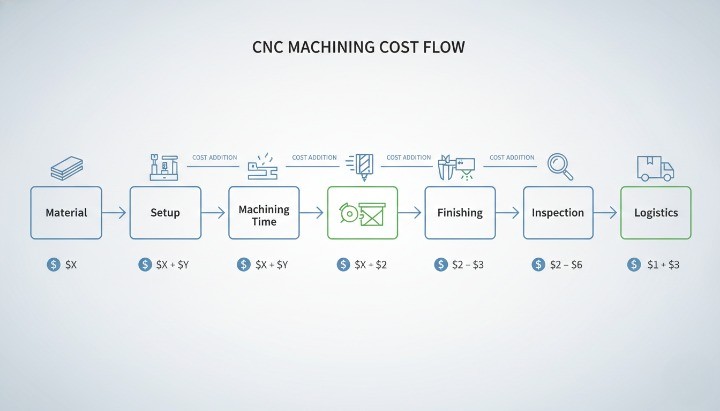
Most CNC manufacturers follow a straightforward cost structure. They estimate machining time based on the part geometry and multiply it by the hourly rate of the machine. Then they add material, setup, finishing, and inspection cost. The typical cost model looks like this:
-
Material Cost
-
Machining Time × Machine Hourly Rate
-
Setup and Programming Cost
-
Tooling and Tool Wear Cost
-
Surface Finishing Cost
-
Inspection Requirements
-
Packaging and Logistics Cost
Machining time often accounts for 50–70% of the total cost because the spindle time, toolpath complexity, and cutting conditions directly determine how long a part stays on the machine. As a result, features such as deep pockets, tight radii, small tool sizes, or heavy material removal make an immediate impact on both cycle time and overall cost.
Direct vs. indirect cost components
Direct costs include all items tied directly to your part: raw materials, tool life, machine operation time, and operator labor. These costs scale with the quantity you order. Indirect costs include factory overhead, energy consumption, machine depreciation, programming time, and fixture preparation. You typically see these costs reflected in setup fees or embedded in the hourly machining rate.
You influence direct costs through design and tolerance choices. For example, reducing a deep pocket depth or increasing a radius often cuts machining time significantly. Indirect costs depend on the supplier’s equipment level and workflow efficiency. A shop with modern high-speed machines may produce the same part faster, allowing them to offer lower unit prices without compromising quality.
Hidden cost factors most buyers overlook
Several cost drivers do not appear in a quote but directly impact the price you pay:
-
Tool Access Constraints: If the cutter cannot reach an internal feature easily, the machinist slows down feed rates or changes tools often.
-
Scrap Rate: Tight tolerances, thin walls, and certain materials increase the scrap rate, raising the cost to maintain consistent quality.
-
Fixture Complexity: Irregular shapes or multi-sided machining require custom fixtures, adding time and setup effort.
-
Over-Specification: Choosing tolerances tighter than a part actually needs often increases cycle time and inspection cost.
-
Low Volume Production: When you only order a few pieces, setup cost becomes a high percentage of the unit price.
When you understand these hidden drivers, you can adjust your design or tolerance strategy to reduce machining time and improve cost efficiency without sacrificing performance.
Material Cost
Material cost is the first measurable component in any CNC machining quote, and it often sets the baseline for overall pricing. You influence this cost through your choice of alloy, stock size, and how efficiently the material can be machined. Because different materials vary widely in both price and machinability, selecting the right one has a direct impact on total cost.
Material price differences (Aluminum, Steel, Copper, Plastics)
Material prices fluctuate based on global market trends, alloy grade, and region. In CNC machining, some materials cost significantly more not only because of raw price per kilogram but also because they are harder to machine.
Typical material cost range (per kg):
| Material Type | Common Grades | Relative Cost Level | Notes for CNC Machining |
|---|---|---|---|
| Aluminum | 6061, 6082, 7075 | Low–Medium | Excellent machinability, widely used |
| Steel | 1018, 4140, Stainless 304/316 | Medium–High | Higher tool wear and slower feed rates |
| Copper/Brass | C110, C360 | High | Soft but sticky; reduces tool life |
| Plastics | POM, ABS, Nylon, PEI | Low–Medium | Easy to cut, but can deform from heat |
Aluminum offers the best balance of strength, weight, machinability, and cost, making it the most common choice for CNC machining. Stainless steel and copper-based alloys, meanwhile, increase machining time due to lower cutting speeds and heavier tool wear, which leads to higher unit prices.

Machinability and scrap rate impact
Machinability determines how fast a tool can cut the material and how often it needs to be replaced. Materials such as stainless steel, titanium, and pure copper slow down cutting speeds significantly. This increases machine hour consumption and tool costs.
Materials with poor thermal stability or internal stress—like plastics prone to warping or cast metals with porosity—can cause scrap or rework. A higher scrap rate increases the real cost of good parts, especially when tolerances are tight. For example, tolerances below ±0.01 mm on stainless steel often require slower toolpaths, repeated inspection, and potentially more rework.

Stock size, block size, and material utilization efficiency
Material utilization is often an overlooked cost driver. If your part requires oversized stock, the extra unused material raises total cost—especially with expensive metals. For example, a block machined from a billet with 70% waste material may cost more than redesigning the part for better nesting or using near-net-shape blanks.
Suppliers consider:
-
Stock size availability
-
Need for custom-sized billets
-
Material yield for milling or turning
-
Shape complexity and volume removed
Parts with large cavities or thick profiles may remove up to 80% of the stock volume. While machining such shapes is common, the extra raw material and extended milling time directly increase cost.
China vs Western material cost comparison (real expectations)
Material prices in China are generally lower than in the US or EU, but the difference varies by alloy. Aluminum and common steels may cost 10–25% less, while specialized alloys such as titanium or high-end plastics often show only minimal differences because global supply chains are similar.
However, the real advantage lies in machining efficiency and labor cost, not the raw material itself. Even when material prices are comparable, Chinese suppliers often deliver lower total cost due to faster workflow, flexible sourcing, and competitive machining rates. Still, buyers should confirm material certification to ensure compliance with standards such as ASTM, DIN, or GB/T.
Machining Time — The Largest Cost Driver
Machining time is the single most influential factor in CNC pricing because it directly dictates how long the machine, operator, and tooling are engaged with your part. Even small design changes—like reducing wall height, adjusting a radius, or widening a slot—can cut machining time by minutes or even hours. This is why many suppliers evaluate machining time before anything else in a quotation.
Hourly rates by machine type (3-axis, 5-axis, turning, EDM)
Machine hourly rates vary by region, machine capability, and the shop’s operating cost structure. More advanced equipment, such as 5-axis mills or wire EDM machines, demands higher hourly rates because of the precision and automation features involved.
| Machine Type | Typical Hourly Rate (China) | Typical Hourly Rate (US/EU) | Notes |
|---|---|---|---|
| 3-Axis CNC Mill | $20–$35/hr | $65–$120/hr | Most economical and widely available |
| 5-Axis CNC Mill | $40–$75/hr | $120–$200/hr | Higher precision and multi-face machining |
| CNC Turning | $15–$30/hr | $60–$110/hr | Cost-effective for round or symmetrical parts |
| Wire EDM | $30–$60/hr | $100–$180/hr | Best for sharp corners or hardened steels |
The spread between machine types can be large. A part that requires 5-axis machining instead of 3-axis may double the hourly rate and significantly increase programming time.

Features that increase machining time (thin walls, deep pockets, tight radii)
Certain design features require slower toolpaths, multiple setups, or specialized tooling. These features extend cycle time and often raise scrap risk.
Common cost-increasing features include:
-
Thin walls below 1.0–1.5 mm (risk of vibration and deformation)
-
Deep pockets with depth-to-width ratios above 4:1
-
Small internal radii that require slow, precise end mills
-
Complex 3D surfaces that need long finishing passes
-
Hard-to-reach areas requiring 5-axis positioning
Even a simple design choice—such as increasing an internal radius from 0.5 mm to 2 mm—can allow the use of a larger, faster cutting tool and reduce cycle time dramatically.

Regional differences in hourly machining cost
Regional cost differences directly affect the machining-time component of your quote. China offers some of the lowest global machining rates due to competitive labor, streamlined production workflows, and high machine utilization rates.
Typical differences:
-
China: $15–$75/hr depending on machine type
-
Eastern Europe: $35–$90/hr
-
Western Europe & US: $65–$200/hr
The hourly rate affects more than price—it influences how shops optimize workflow. For example, Chinese shops often invest in faster toolpath strategies because shorter cycles allow higher throughput. Western shops, facing higher overhead, may lean more heavily on automation or lights-out machining to reduce per-part cost.
These differences do not necessarily reflect quality. Many high-end aerospace, medical, and robotics parts are produced in China with the same global-standard equipment, such as Haas, Mazak, DMG Mori, and Brother machines.
Part Design Complexity
Design complexity has a direct and sometimes dramatic impact on CNC machining cost. When a part features intricate geometry, narrow cavities, or multiple angled surfaces, the machining path becomes longer and more complicated. This leads to additional setups, specialized tooling, or slower cutting speeds. Complexity is one of the first things engineers and machinists evaluate because it shapes the entire cost structure—from programming to cycle time to inspection.
Geometry factors that increase cost
Certain geometric elements force the machine to work slower, change tools frequently, or run multiple setups. These factors increase machining time, programming effort, and scrap probability.
Common geometry-driven cost escalators include:
-
Deep pockets requiring slow step-down passes to avoid tool breakage
-
Sharp internal corners that demand small end mills and long finishing cycles
-
Undercuts or T-slots that require specialty tools or extra setups
-
Very tall features or long aspect ratios that create vibration and require slow feed rates
-
Thin sections or ribs that risk deformation under cutting pressure
Even minor adjustments can dramatically change cost. Increasing a pocket radius, reducing pocket depth, or thickening walls often cuts cycle time by 20–40%.

5-axis vs 3-axis: when higher-axis machining is necessary
Most parts can be completed on 3-axis machines, which keeps cost low. However, some parts demand 5-axis machining due to geometry constraints.
You typically need 5-axis machining when:
-
Multiple faces require continuous machining without re-fixtures
-
Features sit at compound angles
-
The part includes organic or freeform surfaces
-
Tight tolerances must be maintained across multiple sides
-
Undercuts or deep curvature make 3-axis inaccessible
While 5-axis machining reduces setup time and improves accuracy, the hourly rate is significantly higher. Choosing 5-axis should be a strategic decision, not a default option. For many engineering teams, this is where early design-for-manufacturing (DFM) reviews prevent unnecessary cost increases.
Feature simplification opportunities for cost reduction
Many parts can achieve the same function with simpler geometry. Small design adjustments can lead to meaningful savings without sacrificing performance. Some of the most effective simplifications include:
-
Replace sharp corners with larger radii to allow faster cutters
-
Standardize hole sizes to reduce tool changes
-
Avoid unnecessary surface curvature that requires long 3D finishing passes
-
Increase wall thickness to improve part stability during machining
-
Eliminate non-functional chamfers or engravings
-
Switch from deep pockets to ribs or cutouts where possible
These changes often reduce machining time by 15–50%, especially on complex housings, brackets, or structural components. For procurement teams, asking a supplier for alternative machining strategies or simplified geometry is one of the fastest ways to achieve cost reduction.
Tolerances & GD&T — Their True Cost Impact
Tolerances and GD&T symbols are among the strongest cost drivers in CNC machining. While tight tolerances improve fit and performance, they also slow down machining, increase scrap rate, and require more inspection time. Understanding which tolerances are genuinely needed—and which are not—has a direct impact on production cost. Many buyers unknowingly request precision levels designed for aerospace or medical devices when their application does not require it, resulting in unnecessary expense.
Standard tolerances vs precision tolerances
Standard machining tolerances typically fall within ±0.05–0.1 mm for milling and ±0.01–0.03 mm for turning. These tolerances are achievable on most modern machines without slowing down production. Precision tolerances, such as ±0.01 mm or tighter, require slower feeds, controlled tool wear, additional setups, and sometimes climate-controlled environments.
Key differences include:
-
Cycle time increases because tools must remove material in smaller increments
-
Tool wear becomes faster, requiring more frequent replacements
-
Additional finishing passes like reaming, honing, or lapping may be needed
-
Setup becomes more sensitive, requiring experienced machinists
A part that uses standard tolerances can often be completed 2–4 times faster than one requiring precision tolerances. When multiplied across batches, the cost difference becomes significant.

How tight tolerances increase cycle time & scrap rate?
When tolerances tighten, machining becomes a careful balancing act. The machine must cut slowly enough to maintain dimensional accuracy while minimizing vibration, heat buildup, and deflection. This has several consequences:
-
Slower feeds and speeds extend total cycle time
-
Multiple tool offsets are checked throughout the run
-
Dimensional drift requires in-process measurement
-
Scrap risk increases, especially for long, thin, or complex parts
-
Rework becomes more common when dimensions fall outside acceptable ranges
On high-value materials such as stainless steel, titanium, or copper alloys, scrap becomes particularly costly. For this reason, engineers must determine whether every tight tolerance contributes to functionality or merely reflects default CAD settings.
GD&T controls that significantly raise cost (position, flatness, concentricity)
GD&T offers clarity and ensures functional performance, but not all symbols carry the same cost weight. Some dramatically increase machining and inspection requirements. The most cost-sensitive GD&T controls include:
-
True position for hole patterns or mating features
-
Flatness on large or thin surfaces
-
Concentricity or runout for rotating shafts
-
Profile tolerance on contoured surfaces
-
Parallelism or perpendicularity with tight ranges
These requirements typically lead to:
-
More setups
-
Precision fixturing
-
100% CMM inspection
-
Slower machining passes
-
High tooling stability requirements
Buyers often add GD&T symbols for clarity, but each symbol must match a functional need. Otherwise, you risk paying for tolerances that will never affect real-world performance.

Practical tolerance optimization rules
A structured approach to tolerance selection can reduce cost without affecting quality. Some proven guidelines include:
-
Apply tight tolerances only to mating or functional areas
-
Use standard tolerances everywhere else
-
Increase tolerance values where aesthetics—not function—are the priority
-
Avoid stacking multiple tight tolerances in a single assembly
-
Let the supplier recommend tolerance relaxation where safe
-
Review CAD models for default “overly tight” tolerances accidentally applied
Many suppliers report that 20–40% of tight tolerances on incoming drawings serve no actual function. A collaborative tolerance review with a professional CNC manufacturer often uncovers quick savings with zero performance compromise.
Programming, Setup & Tooling
Programming, setup, and tooling form the foundation of CNC machining cost because they determine how efficiently a part can be produced. These steps do not appear on the final part, yet they influence quality, consistency, and the economics of production. Understanding these cost components helps you evaluate quotes more accurately and ask the right questions during supplier selection.
Setup and programming involve preparing machines, creating toolpaths, selecting cutters, verifying safety margins, and ensuring that all fixtures hold the part securely. These activities require time and skilled labor, which means they affect cost even before the first part is produced. For complex geometries, setup may take longer than the actual machining time, especially during prototyping or when a supplier needs to build custom fixtures.

One-time setup and fixture preparation
Setup includes preparing the machine, loading tools, installing fixtures, aligning stock material, and validating the first piece. These steps are typically charged as a one-time cost, especially for prototypes or small batches. When a job requires custom fixtures, the setup cost increases because the supplier must design, fabricate, and test the fixture before production.
Setup cost impacts your project in three main ways:
-
Initial preparation time increases when a part has multiple orientations or requires 4-axis or 5-axis repositioning
-
Fixture complexity affects repeatability, especially for thin-walled or long components
-
First article verification takes longer for precision work or high-risk materials such as stainless steel, titanium, or copper alloys
For simple aluminum prototypes, setup might take 30–60 minutes. For complex assemblies or multi-operation parts, it can extend to several hours. This is why setup cost becomes more noticeable at low volumes: the cost is not spread across many units.
CAM programming effort
Programming involves converting your 3D model into optimized toolpaths that the CNC machine follows. This requires knowledge of material behavior, cutter geometry, and machining strategy. High-quality CAM programming reduces cycle time, tool wear, and scrap risk, which means a well-programmed job often saves money in the long run.
Programming time depends on:
-
Number of features
-
Required operations (milling, drilling, tapping, contouring)
-
Use of 4-axis or 5-axis strategies
-
Surface finish requirements
-
Tolerance and GD&T specifications
Simple parts may take 10–20 minutes to program, while complex 5-axis components with blended surfaces or organic geometry can require several hours. Some suppliers include this cost within the machining price; others list it separately. Understanding how your supplier handles programming helps you compare quotes more accurately.

Special tools, micro-tools, and tool wear cost
Tool selection has a major influence on machining efficiency. Standard cutters are affordable and widely used, but certain features—like micro-channels, deep pockets, hard metals, or sharp internal corners—require specialty tooling.
Several conditions increase tooling cost:
-
Micro-tools for tiny holes or features below 1 mm
-
Long-reach tools for deep cavities
-
PCD or carbide tools for abrasive materials
-
Custom form tools for unique profiles
-
High-wear conditions caused by stainless steel, titanium, or copper alloys
Tool wear is also a real cost factor. When machining hard or gummy materials, tools must be replaced more frequently, and this cost is reflected in the quote. A supplier that factors in tool wear realistically will produce stable quality and reduce the risk of dimensional drift during long production runs.
Tooling also affects cycle time. Sharp tools allow faster feeds and reduce time per pass, while worn tools slow down machining and increase the chance of defects. This is why a CNC manufacturer with an organized tooling system can deliver more consistent pricing and better reliability.
Production Volume & Batch Size
Production volume shapes CNC machining cost more than most buyers expect. Even when the part design stays the same, the unit price can shift dramatically depending on whether you order one piece, a small batch, or a recurring production run. Understanding how batch size affects setup, tooling, and material usage helps you choose the most efficient purchasing strategy for your project.
When you increase quantity, the supplier spreads setup and programming costs across more units, runs machines more efficiently, and reduces the risk of material waste per part. These dynamics create meaningful savings for procurement teams that manage multi-stage development cycles—from prototyping to pre-production to mass production.
Prototype vs small batch vs mass production
Production volume influences cost in three ways: setup amortization, machining strategy, and process optimization. Prototypes usually have the highest unit price because the supplier must perform full setup and programming for only a few parts. Small batches—often between 10 and 100 units—benefit from moderate setup distribution, but still require manual loading and part handling. Mass production, especially at 500 units or more, allows the manufacturer to fine-tune speeds, build dedicated fixtures, and streamline the machining workflow.
For example:
-
Prototype (1–5 units): highest cost per part; setup dominates
-
Small batch (10–50 units): setup still matters, but repeatability improves cost
-
Medium batch (100–500 units): cycle time optimization begins
-
Mass production (>500 units): most efficient; custom fixtures significantly reduce unit cost
Each stage serves a specific purpose in your development timeline. Matching volume to product maturity helps manage budget while maintaining design flexibility.

Setup cost amortization
Setup is a fixed cost. Whether you order one part or 1,000, the fixture preparation, tool loading, machine zeroing, and first-piece validation must be completed. This is why the first unit costs the most. When quantity increases, the setup cost spreads across all parts, reducing the unit price dramatically.
A clear example:
-
Setup cost: $120
-
Prototype order quantity: 2 units → $60 setup cost per unit
-
Batch order quantity: 100 units → $1.20 setup cost per unit
This explains why many CNC suppliers encourage buyers to place slightly larger batches once the design is stable. As long as inventory levels are manageable, increasing order quantity reduces cost without compromising quality or schedule.
When CNC should transition to die casting?
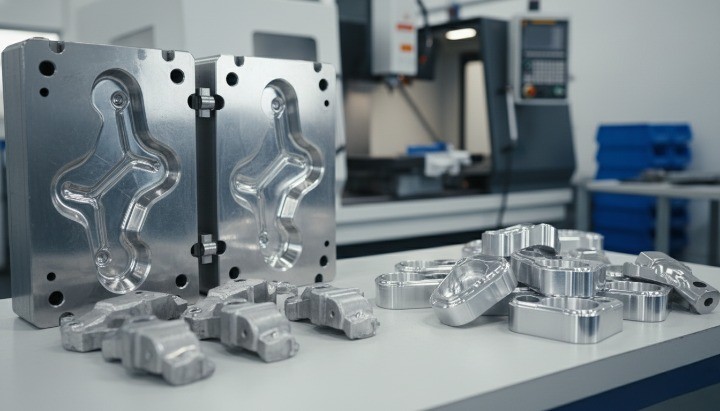
There is a point where CNC machining is no longer the most cost-effective method, especially when you need hundreds or thousands of identical parts. Die casting becomes attractive when the part geometry is suitable and the target volume justifies mold investment.
CNC machining remains ideal when:
-
Tight tolerances are required
-
Geometry changes frequently
-
Demand is low or unpredictable
-
Surface appearance is critical
Die casting becomes more cost-efficient when:
-
Volume exceeds 2,000–5,000 units
-
Part geometry supports draft angles
-
You need consistent, repeatable production
-
Unit price must be minimized for mass markets
However, die casting still requires CNC machining for post-processing, such as tight holes, sealing surfaces, and precision fits. This is why many companies use a hybrid strategy: CNC for prototypes and early batches, die casting for mass production, and CNC finishing for critical features.
Surface Finishing & Post-Processing
Surface finishing plays a meaningful role in CNC machining cost because it affects both appearance and functional performance. Most buyers focus on machining time, yet finishing can add 10–40% to the total part cost depending on requirements. Understanding which finishes are necessary—and which are optional—helps you manage budget without compromising durability or aesthetics. Different industries demand different levels of appearance, corrosion resistance, and surface texture, so the finishing plan should always match the final application.
Finishing is not just cosmetic. It can impact tolerance stability, add additional processing steps, and introduce new quality checks. This makes it an important cost factor for procurement teams looking for predictable pricing and consistent results.

Anodizing, plating, painting, powder coating
Each finishing process contributes differently to the total cost. Anodizing remains popular for aluminum because it adds corrosion resistance without changing dimensions significantly. Plating is common for steel and copper alloys but usually costs more because it requires pre-polishing and controlled chemical baths. Painting and powder coating are often chosen for visual products or outdoor components, but their price varies depending on color matching, thickness, and durability requirements.
A simplified comparison:
-
Anodizing: economical; suitable for aluminum parts in electronics, robotics, and general industrial use
-
Plating (e.g., nickel, chrome): higher cost; improves corrosion resistance and appearance
-
Powder coating: durable; suitable for structural components and enclosures
-
Painting: flexible color options; costs rise with precision masking
The right choice depends on whether your application values aesthetics, corrosion resistance, electrical insulation, or wear protection.
Polishing, deburring & edge finishing
These manual or semi-automated processes add time and labor. Polishing improves visual appearance, removes tool marks, and prepares surfaces for anodizing or plating. Deburring removes sharp edges, ensuring safe handling and proper assembly. Edge finishing improves fit quality, especially for sliding or rotating parts.
The cost impact depends on three factors:
-
Surface roughness requirement (Ra value)
-
Accessibility of internal edges
-
Manual labor needed per part
For example, requiring a mirror finish or Ra < 0.8 μm may double or triple post-processing cost. On the other hand, simple deburring adds minimal cost but significantly improves assembly performance.
Tolerances affected by finishing processes
Finishing can alter dimensions. Anodizing adds a thin oxide layer; plating adds thickness; painting and powder coating add measurable build-up that may affect holes, slots, and critical surfaces. This means engineers must coordinate tolerance strategy with finishing specifications to avoid assembly issues or rework.
Key considerations:
-
Anodizing thickness: typically 8–25 μm
-
Plating thickness: can reach 50–100 μm depending on type
-
Painting/powder coating: 50–150 μm thickness range
When dimensions must remain exact, the supplier may mask critical features or machine them to pre-compensated dimensions. Both options increase cost. For this reason, it’s helpful to specify only the surfaces that require cosmetic finishing while leaving hidden areas uncoated.
Inspection & Quality Assurance
Inspection and quality assurance shape CNC machining cost more than most buyers expect. These steps confirm that every part meets dimensional, geometric, and functional requirements. The stricter the inspection plan, the higher the cost—because it increases measurement time, equipment usage, documentation, and operator skill demand. For high-accuracy parts used in automotive, aerospace, robotics, or medical applications, the quality process may represent 10–30% of the total manufacturing cost.
Inspection is not optional. You rely on it to ensure consistency, reduce assembly failures, and avoid the risk of hidden defects entering your supply chain. For global procurement teams, a predictable and transparent quality process is essential for stable long-term sourcing.

CMM/optical measurement cost
CMM (Coordinate Measuring Machine) and optical inspection systems verify tight tolerances, GD&T requirements, and complex geometries. They are essential for features such as concentricity, position, true runout, or critical shaft dimensions. Although these tools provide high accuracy, they add meaningful cost because they require program setup, measurement time, and skilled operators.
Examples of when CMM inspection becomes necessary:
• Tolerances of ±0.01 mm or tighter
• GD&T callouts involving position, flatness, or profile
• Complex 3D contours from 5-axis machining
• High-risk applications like medical or aerospace components
Costs increase when parts have many measured points, internal features, or require multiple inspection stages. For procurement teams, understanding which features require CMM helps you avoid overpaying for unnecessary checks.
FAI, PPAP & certification fees
Some industries require documented validation before production begins. These processes add administrative and technical effort because the supplier must prepare detailed reports, measurement records, material certifications, and process documentation.
Common requirements include:
-
FAI (First Article Inspection): documents every key feature
-
PPAP (Production Part Approval Process): required in automotive sourcing
-
Material certificates and RoHS/REACH compliance: for regulated markets
-
Dimensional reports for each batch: necessary for high-precision components
These documents improve traceability and reduce risk, but they add cost due to the time needed for preparation and verification. For low-volume projects, certification cost may feel disproportionate, so it’s important to request only the documents required by your industry.
High-precision quality requirements
When tolerances tighten, the quality plan becomes more demanding. High-precision components require controlled measurement environments, calibrated tools, and repeat verification steps to ensure stability. This increases inspection frequency and documentation effort.
Examples of factors that raise quality cost:
-
Higher sampling rates (e.g., measuring every part instead of 1/20)
-
Dimensional tracking to monitor process drift
-
In-process inspection during long machining cycles
-
Special gauges or custom fixtures
For engineers and procurement teams, the best approach is to define inspection needs based on functional risk—not habit. Overspecifying quality requirements increases cost without improving part performance.
Real CNC Machining Cost Examples
Real-world cost examples help you understand how CNC machining pricing behaves across different materials, geometries, and tolerance levels. These examples simplify the cost model by showing how material cost, machining time, tolerance requirements, and finishing combine into a final unit price. You make better sourcing decisions when you see how each variable influences the complete cost structure.
To keep the analysis meaningful, each example reflects realistic market data from China-based precision machining suppliers and typical global pricing ranges.
Aluminum milled part — standard tolerance
A simple aluminum milled block shows how standard tolerances and common features affect pricing. Most suppliers consider ±0.10 mm to ±0.05 mm as general machining tolerance, and these values keep the cost predictable.
Typical characteristics:
• Material: 6061-T6 aluminum • Size: 80 × 60 × 20 mm
• Features: pockets, chamfers, threaded holes
• Tolerance: ±0.10 mm
• Finish: bead blasting + clear anodizing
Cost breakdown example:
| Cost Component | Typical Range | Notes |
|---|---|---|
| Material | Low | Aluminum has favorable machinability and low scrap cost |
| Machining Time | Moderate | Simple pocketing and drilling operations |
| Tolerance | Low Impact | Standard tolerance keeps cycle time stable |
| Finishing | Moderate | Anodizing adds predictable cost per piece |
| Inspection | Standard | Basic dimensional checks only |
| Total Cost | Low–Medium | Most economical CNC category |
This type of part often lands between $8–$20 per piece in China for small batches. Pricing rises slightly for thicker materials or deeper pockets, but the geometry remains fundamentally cost-efficient.

Stainless steel shaft — tight tolerance
A precision shaft shows how tight tolerances dramatically influence CNC machining cost. Stainless steel introduces challenges such as slower cutting speeds, heat buildup, and tool wear. When tolerances reach ±0.01 mm or involve GD&T controls like concentricity, suppliers invest more in fixturing, inspection, and repeatability.
Typical characteristics:
• Material: 303 or 304 stainless steel
• Size: Ø20 × 120 mm
• Features: shoulders, grooves, external threads
• Tolerance: ±0.01 mm with concentricity requirement
• Finish: fine turning + polishing
Cost breakdown example:
| Cost Component | Typical Range | Notes |
|---|---|---|
| Material | Medium | Stainless steel costs more per kg |
| Machining Time | High | Slow feed rates and extra passes to hit tolerance |
| Tolerance | High Impact | Tight tolerances increase scrap rate |
| Finishing | Low–Medium | Polished surfaces require more manual work |
| Inspection | High | CMM required for concentricity and diameter |
| Total Cost | High | Precision tolerance drives complexity |
Many suppliers quote $20–$60 per piece depending on the batch size. Cost reduces significantly when tolerances relax or surface roughness requirements decrease.

CNC vs die casting — break-even analysis
A cost comparison helps buyers understand when it’s time to shift from CNC machining to die casting. CNC machining works best for prototypes, low-volume production, and parts requiring high precision. Die casting becomes more cost-effective when geometry stabilizes and batch volume grows.
Scenario example:
Part: Aluminum housing CNC machining unit cost (small batch): $25–$40 per piece Die casting mold cost: $3,000–$6,000 Die casting unit cost (mass production): $2–$5 per piece
Break-even point:
| Volume | CNC Machining | Die Casting | Preferred Process |
|---|---|---|---|
| 1–100 pcs | $25–$40/pc | Not economical | CNC |
| 100–500 pcs | $20–$35/pc | Mold cost too high | CNC |
| 500–3,000 pcs | $18–$30/pc | $3–$6/pc + mold cost | Depends on design stability |
| 3,000+ pcs | $15–$30/pc | $2–$5/pc | Die casting |
Buyers often switch once annual demand exceeds 3,000–5,000 pcs, especially when the part geometry suits die casting and surface finish requirements can be managed with post-machining.
How to Reduce CNC Machining Cost (Practical Checklist)?
Reducing CNC machining cost starts with design clarity and realistic tolerance planning. You lower cost when your part removes unnecessary complexity and aligns with how machining actually works. Most buyers see immediate savings when they simplify geometry, relax non-critical tolerances, and standardize features. This section gives you a step-by-step checklist that addresses the biggest cost drivers in both machining time and setup effort.

Geometry simplification
Simple geometry always costs less to machine because it reduces tool changes, cuts machining time, and lowers the chance of scrap. When your part avoids deep cavities, fragile structures, and narrow internal radii, the supplier can run faster feeds and improve tool life.
Key strategies that consistently lower machining cost:
• Increase internal radii to match standard tool diameters.
• Avoid deep pockets over 4× their width, which require multiple roughing passes.
• Remove cosmetic grooves, engravings, and unnecessary surface cuts.
• Thicken thin walls to improve rigidity during machining.
• Consolidate levels and steps to reduce manual setups.
You gain the greatest savings when the part geometry aligns with 3-axis machining, since 5-axis milling increases hourly rates and setup requirements.
Tolerance optimization
Tight tolerances often multiply cost because they affect machining speed, tool choice, and inspection time. Many parts include several ±0.01 mm features even when only two or three of them are functionally critical. If you remove these blanket tolerances, machining becomes faster and more consistent.
Actions that reduce cost while protecting function:
• Apply tight tolerances only to press fits, bearing seats, or sealing surfaces.
• Use ±0.10 mm to ±0.05 mm for most non-critical dimensions.
• Replace size tolerances with GD&T controls only when they improve function.
• Avoid mixing tolerance classes that force tool changes mid-process.
• Match tolerances to the capabilities of aluminum, steel, or plastics
You keep costs predictable when you understand how each tolerance influences machining stability. Small adjustments often remove hours of unnecessary set-up and rework, especially on complex multi-axis parts.
Standardized hole sizes, threads, radii
Standardization is one of the easiest ways to reduce CNC cost because it lets the machinist use common tools instead of switching between custom diameters. Every tool change adds setup time, and uncommon tool sizes increase wear and risk.
Practical standardization methods include:
• Use common drill diameters (e.g., 3 mm, 6 mm, 8 mm, 10 mm) instead of in-between sizes.
• Choose standard thread sizes such as M6, M8, M10, ¼-20, or ⅜-16.
• Match internal corner radii to standard end mills (e.g., R2, R3).
• Keep countersink and counterbore sizes within ISO and ANSI standards.
• Use uniform hole depths whenever possible to simplify toolpath programming.
These changes reduce machining time, minimize tool inventory, and help ensure consistent dimensional accuracy across batches.
Batch production & supplier collaboration
You lower cost dramatically when you scale production and involve your supplier early. Machining cost is highly sensitive to setup time, and that setup stays the same whether you make 5 parts or 500. When you increase batch size, the setup cost spreads across more units, reducing the price per piece.
Ways to optimize cost through collaboration:
• Share projected volume early so the supplier can plan tooling and fixturing.
• Ask for a Design for Manufacturability (DFM) review before finalizing drawings.
• Combine multiple small orders into one batch when timing allows.
• Request feedback on which features slow machining the most.
• Work with a supplier that integrates machining and finishing to avoid multiple mark-ups.
A collaborative relationship helps you eliminate unnecessary costs before production begins, improving both pricing and lead time.
How to Evaluate Supplier Quotes Effectively?
You can filter strong CNC suppliers from weak ones by looking at how they build their quotes. A clear and detailed quote helps you understand where the money goes and whether the price aligns with the complexity of your part. A vague quote often hides inflated margins, missing processes, or inconsistent assumptions that create unexpected costs later.

What a transparent CNC quote must include?
A reliable supplier shows exactly how the cost is formed. You should expect a quote to break down:
• Material type, grade, and weight
• Machining time for each major operation
• Machine type (3-axis, 5-axis, turning, EDM)
• Setup and programming fees
• Finishing, heat treatment, and inspection steps
• Packaging and shipping assumptions
• Lead time and batch size requirements
This transparency builds trust and helps you compare quotes on equal terms. Strong suppliers also provide notes explaining risk points such as difficult features, scrap risk, or tolerance challenges. When a supplier explains their reasoning openly, you get more predictable production outcomes.
Common red flags in overpriced quotations
You avoid unnecessary cost when you know how to spot signals of inflated pricing. Some of the biggest warning signs include:
• A single lump-sum price with no breakdown
• Missing details on machine type or machining hours
• Extra fees added at the end without explanation
• Overuse of “tight tolerance” justification where it isn’t required
• Material listed without grade or spec
• Unusually high setup charges for simple parts
• Finishing or inspection priced without referencing standards
These red flags usually indicate either lack of expertise or lack of transparency. Both lead to inconsistencies, delays, and escalating costs.
Comparing China vs US/EU suppliers — what’s realistic?
Buyers sometimes expect every Chinese supplier to provide extremely low prices and every Western supplier to be expensive. The real cost landscape is more nuanced.
A realistic comparison often looks like this:
• Hourly machining rates in China remain lower, especially for 3-axis and turning jobs.
• Western suppliers may have higher hourly rates but often provide stronger documentation and certification processes.
• China excels at mid-volume to high-volume CNC production where efficiency compounds over time.
• Certain specialty operations—high-performance alloys, aerospace-grade inspection—may be more cost-effective in US/EU shops.
You achieve the best results when you compare suppliers based on value, not just hourly rates. A good supplier, regardless of region, offers predictable quality, fast communication, and a clear breakdown of cost.
CNC Machining vs Die Casting vs 3D Printing
You reduce manufacturing cost more effectively when you match each process to the right type of part. CNC machining, die casting, and 3D printing each have strengths, limitations, and cost patterns. Understanding the break-even point helps you choose the most economical process based on geometry, volume, and performance requirements.

When CNC is most economical?
CNC machining offers the best value when you need precision, stability, and material flexibility. You gain the most cost efficiency when:
• The geometry is simple to moderately complex
• Volumes stay in the prototype to low- or mid-range
• Material strength matters (aluminum alloys, stainless steel, copper)
• Tolerances fall within tight or engineering-grade ranges
• Cosmetic or structural surfaces must be consistent
CNC eliminates the need for tooling, so you avoid upfront investment. This makes it ideal for early-stage product development and lower-volume production where design revisions can happen frequently. You also benefit from reliable surface quality and predictable dimensional accuracy that alternative processes may struggle to match.
When die casting reduces unit price?
Die casting becomes the most cost-effective option once your volume grows. You see major savings because the process spreads tooling investment over a large batch. Die casting works best when:
• Volumes exceed the typical break-even point of 3,000–10,000 units
• The material requirement fits zinc or aluminum alloys
• You accept tooling lead time and upfront cost
• The part has walls and features suited to casting flow rules
• Post-machining can be limited to a few critical surfaces
Once you pass the break-even volume, the per-unit cost drops dramatically. Many manufacturers shift from CNC to die casting when scaling a validated design because it delivers lower material cost, faster cycle time, and consistent repeatability at mass-production levels.
When 3D printing beats CNC in cost efficiency?
3D printing provides a cost edge when geometry becomes complex or impossible to machine. You gain financial and design advantages when:
• The part has organic, lattice, or topology-optimized structures
• You want to avoid multi-axis machining or heavy material removal
• You only need a few units
• Lead time matters more than surface perfection
• You work with prototype-only shapes or validation models
Additive manufacturing removes restrictions tied to machining accessibility, tool paths, and fixture angles. While the surface finish and tolerance levels may require post-processing, the ability to produce complex shapes with minimal labor can significantly cut cost in early development phases.

CNC Machining Cost FAQs
This section answers the questions engineers, buyers, and technical teams ask most often when estimating CNC machining cost. Each response gives clear, actionable guidance so you can set realistic expectations before requesting quotes.
Average machining cost ranges
The cost of CNC machining varies widely depending on material, geometry, tolerance levels, and regional pricing. However, most parts fall within predictable ranges. Standard aluminum parts with moderate complexity typically cost between $30 and $150 per unit at low volumes, based on data published by multiple manufacturing cost benchmarks and industry surveys. Stainless steel, copper alloys, and engineering plastics can increase the cost because they affect machining time and tool wear. When you estimate budgets, you should always consider part size, stock material, number of setups, finishing needs, and quality requirements, because each factor shifts the final price.
• Simple 3-axis aluminum parts: $20–$80
• Medium-complexity parts: $60–$200
• Tight-tolerance precision components: $150–$400+
• Small-batch stainless steel parts: $80–$300
These figures reflect typical pricing ranges from global CNC suppliers. Actual cost depends on machine time, finishing cycles, and volume.
Cost per hour for different machines
Machine hourly rates represent one of the most significant cost drivers. Rates differ by machine type because of equipment cost, maintenance demands, and operator skill requirements. Most manufacturers calculate hourly rates based on depreciation, shop overhead, labor cost, and expected machine utilization.
Typical hourly rate ranges include:
| Machine Type | Typical Hourly Cost (Global Average) |
|---|---|
| 3-Axis CNC Milling | $30–$60 |
| 4-Axis CNC Milling | $40–$75 |
| 5-Axis CNC Milling | $60–$120 |
| CNC Turning | $25–$55 |
| EDM Wire Cutting | $40–$90 |
| EDM Sinking | $50–$110 |
These numbers reflect trends published across machining cost databases and industry reports. China typically maintains lower hourly rates than the US or EU, primarily because of differences in labor and facility costs.
Why CNC machining seems expensive?
CNC machining often feels expensive because buyers tend to compare it with processes that rely on low-cost tooling or material forming. CNC machining removes material rather than shapes it, which means cost builds through machine time, tool use, and quality control. Material removal also generates scrap, especially with billet production, which adds cost depending on the alloy. When tolerances tighten, cycle time increases because speeds slow down, finishing passes multiply, and inspection becomes more demanding. Labor input also contributes, especially during setups, fixturing, and CAM programming. When you compare CNC machining with die casting or injection molding, it is important to remember that CNC does not benefit from tooling amortization, so each part carries a higher variable cost.

Get a Transparent CNC Cost Breakdown From HM
Why global buyers choose HM for CNC machining & die casting?
You want predictable pricing, reliable lead times, and a partner who understands how engineering decisions affect cost. That is the foundation of HM’s approach. The team provides clear cost models, fast DFM feedback, and consistent machining quality backed by real production data. Many international buyers work with HM because they combine engineering support with competitive pricing, especially for aluminum, zinc, and magnesium components. The company also integrates CNC machining with die casting and post-processing, which helps you evaluate cost trade-offs across different manufacturing routes without contacting multiple suppliers. When projects require tight tolerances, complex geometry, or demanding inspection documentation, HM offers the level of technical detail global procurement teams expect.

Request a custom cost analysis
If you want to reduce uncertainty in your next project, request a complete cost breakdown from HM. You will receive a structured quote that explains material pricing, machining time, finishing options, and inspection requirements in clear terms. Our team can also review your design and suggest practical ways to cut cost without affecting function. A transparent quote gives you better control over budget and supplier selection. If you are ready to begin, reach out with your drawings or 3D models and request a custom machining cost analysis.