


Stainless steel 303 and 304 are used for different manufacturing priorities.
They are often treated as close substitutes because both belong to the austenitic stainless family. In actual production, that assumption can create problems: 303 machines and threads more easily, while 304 holds up better in wet service, welded assemblies, and general fabrication.
This guide explains the real difference between 303 and 304, so you can choose the right grade for stainless steel machining parts, corrosion resistance, fabrication, and total project cost.
A Simple Rule of Thumb
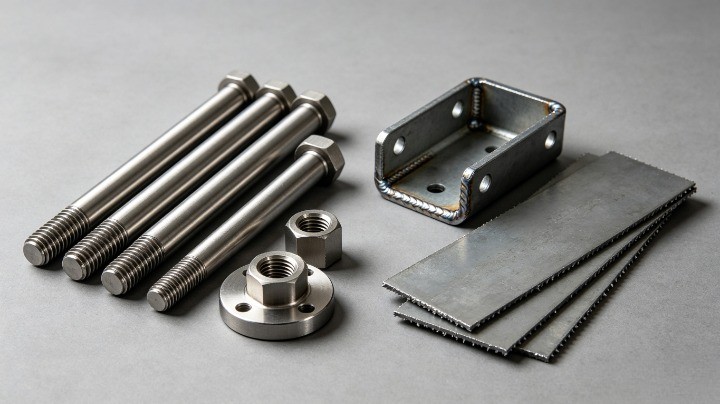
Use 303 when the part is machining-driven. Use 304 when the part is service-driven. 303 is widely treated as the free-machining option in the austenitic family, while 304 remains the more balanced grade for corrosion resistance, weldability, and general fabrication.
If the part is mainly turned, drilled, or threaded from bar stock and will stay in a mild indoor environment, 303 is usually the more efficient choice. If the part needs to handle moisture, welding, forming, or regular washdown, 304 is generally the safer and more practical grade.
| Factor | 303 Stainless Steel | 304 Stainless Steel |
|---|---|---|
| Main advantage | Better machinability | Better corrosion resistance |
| Sulfur content | Higher | Lower |
| Machining behavior | Easier chip breaking | More prone to work hardening |
| Weldability | Poor | Excellent |
| Formability | Lower | Better |
| Typical supply form | Bar, hex bar, precision stock | Sheet, plate, tube, pipe, and bar |
| Best fit | Turned parts, shafts, bushings, threaded fittings | Tanks, brackets, food equipment, enclosures |
What Is the Difference Between 303 and 304 Stainless Steel?
The main difference between 303 and 304 is sulfur content. That one change affects how the material behaves under a cutting tool, in a corrosive environment, and during welding.
303 contains a deliberate sulfur addition to improve machinability. That sulfur helps chips break more easily during turning, drilling, and threading. As a result, machine shops often prefer 303 for parts that involve a lot of material removal.
304 keeps sulfur much lower. That improves corrosion resistance, weldability, and formability. For that reason, 304 is used much more widely in fabricated stainless parts, sheet metal assemblies, tubing, tanks, and food-contact equipment.
This is why the two grades should not be treated as direct substitutes. One is optimized for machining. The other is optimized for broader service performance.
Chemical Composition Comparison
| Element | 303 | 304 |
|---|---|---|
| Carbon | Max 0.15% | Max 0.07% |
| Chromium | 17.0–19.0% | 17.5–19.5% |
| Nickel | 8.0–10.0% | 8.0–10.5% |
| Sulfur | Min 0.15% | Max 0.03% |
| Manganese | Max 2.0% | Max 2.0% |
Even though the chromium and nickel ranges are close, the sulfur difference changes the way each grade performs in production and in service.
Which Grade Machines Better?
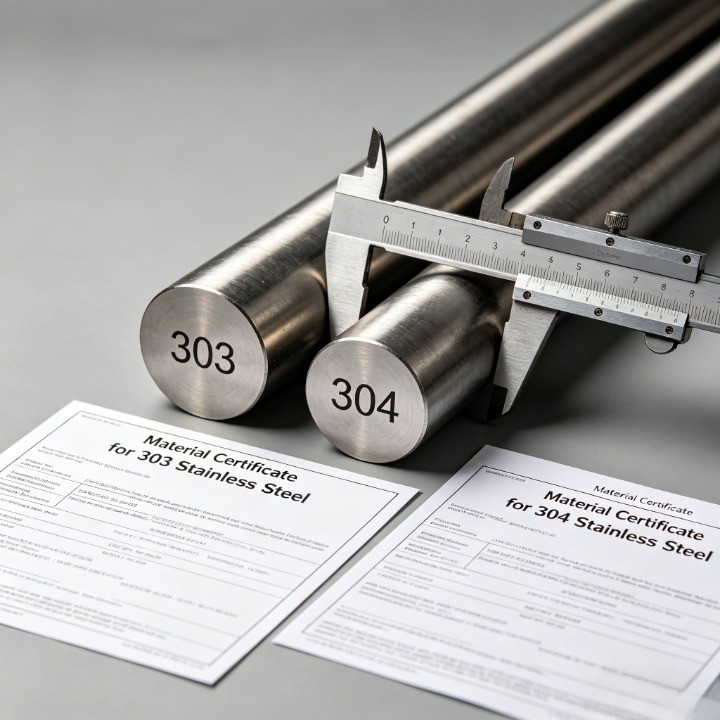
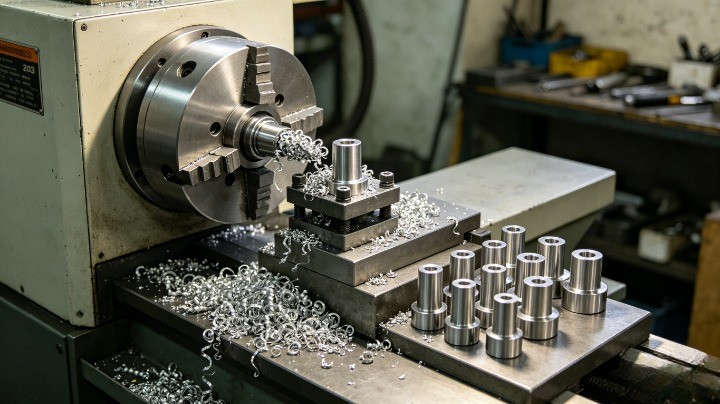
303 machines much better than 304. If your project depends on CNC turning, drilling, tapping, or complex threading, 303 is usually the stronger choice.
The sulfur in 303 helps the chips break more cleanly. That matters because stringy chips can wrap around tools, reduce surface quality, and slow down production. When chips break in a more controlled way, the machine can often run more smoothly and more predictably.
By contrast, 304 has a more gummy cutting behavior. It work-hardens quickly if the tool rubs instead of cutting cleanly. Once the surface hardens, the next pass becomes harder on the tool. That can shorten tool life, slow feed rates, and increase machining cost.
In practice, buyers see the difference in four places:
• cycle time
• tool wear
• thread quality
• production stability
If your part is a precision shaft, a threaded fitting, a spacer, a standoff, or another heavily turned part, 303 often lowers the total machining cost even when raw material price is similar.
However, machining alone should not decide the grade. A material that saves time on the lathe can still become the wrong choice if the final part needs to handle water, detergents, or welding.
Why 303 Is Popular in Screw-Machine Work
303 is often preferred for high-volume bar machining because it makes the production route simpler. Shops can usually control chips better, maintain more stable cycle times, and reduce the risk of thread galling during assembly.
That is one reason 303 is commonly used in:
• threaded fasteners
• fittings
• bushings
• shafts
• precision turned hardware
If your project involves a lot of repetitive machining, 303 can be a very efficient material choice.
Which Grade Resists Corrosion Better?
304 has better corrosion resistance than 303. This is one of the most important differences between the two grades.
The sulfur that improves machinability in 303 also creates weak points for corrosion. In wet, salty, or chemically active environments, those inclusions can become starting points for pitting. That means 303 usually corrodes faster than 304 when both grades are exposed to the same harsh conditions.
304 forms a more reliable passive surface and performs better in general industrial, outdoor, and water-contact environments. That is why 304 is widely used in sanitary equipment, food processing components, tanks, enclosures, and architectural parts.
The simplest rule is this:
• Use 303 in dry, indoor, mildly corrosive service
• Use 304 where water, humidity, cleaning chemicals, or outdoor exposure are involved
If your application includes strong chlorides, salt spray, or marine conditions, you may need to move up to 316 instead of using either 303 or 304.
Why Corrosion Risk Matters in Sourcing
Some buyers focus on manufacturing cost first. That is reasonable. But corrosion failures usually cost more than machining inefficiency. If a cheaper-to-machine material causes staining, pitting, or field replacement later, the original saving disappears quickly.
This is why service environment should be part of the material decision from the start. A part that looks similar on the drawing can need a completely different grade depending on where and how it will be used.
Which Grade Welds and Forms Better?
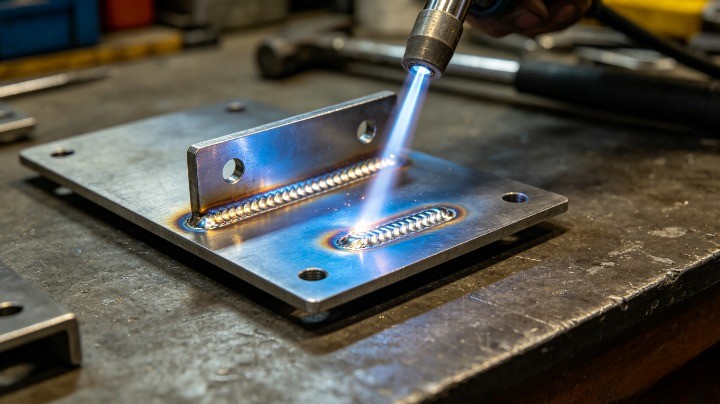
304 welds and forms much better than 303. If your drawing includes welding, bending, stamping, or deep forming, 304 is usually the correct choice.
303 is not a good welding grade. Its sulfur content increases the risk of hot cracking and porosity during fusion welding. That makes it a poor fit for TIG or MIG welded assemblies. It also has lower formability, so sharp bends and demanding forming operations are harder to manage.
304 performs much better in fabrication. It can be bent, stamped, and welded much more reliably. That gives it a major advantage in:
• sheet metal enclosures
• welded brackets
• sanitary assemblies
• formed covers
• structural fabrications
If a buyer chooses 303 only because the part has one machined feature, but the rest of the process involves welding and forming, the wrong material choice can disrupt the entire production route. For general welding-process context, see arc welding vs gas welding.
Why the Manufacturing Route Matters More Than the Alloy Name
Many mistakes happen because buyers ask, “Which grade is better?” That is often the wrong question.
A better question is: What is the manufacturing route?
If the part starts as round bar and ends as a machined component, 303 may be better. If the part goes through cutting, bending, welding, and finishing, 304 usually makes more sense.
That approach leads to better sourcing decisions because it matches the alloy to the actual work.
Do 303 and 304 Have Similar Mechanical Properties?
Yes, their basic mechanical properties are similar enough that strength is usually not the deciding factor. In most sourcing decisions, machinability, corrosion resistance, and fabrication behavior matter more.
Both grades are austenitic stainless steels. Both are commonly supplied in annealed condition. Both cannot be hardened by standard heat treatment in the same way as martensitic grades. That means buyers usually should not choose between 303 and 304 based only on tensile strength tables.
Typical property ranges are close:
| Property | 303 | 304 |
|---|---|---|
| Yield strength | Around 205–300 MPa | Around 205–215 MPa minimum |
| Tensile strength | Around 500–650 MPa | Around 515–620 MPa |
| Elongation | Lower than 304 | Higher than 303 |
| Ductility | Good | Better |
The important difference is not that one is dramatically stronger. The important difference is that 304 is usually more ductile and more fabrication-friendly, while 303 is more machining-friendly.
So when someone asks, “Which one is stronger?” the more useful answer is often, “That is not the main point.” The better question is whether the part will be machined, welded, bent, or exposed to moisture.
Which Grade Is More Cost-Effective?
303 is often more cost-effective for machined parts, while 304 is often more cost-effective for fabricated or corrosion-sensitive parts.
Raw material pricing can vary by market and form, but the bigger cost difference often comes from manufacturing time and downstream risk.
303 can save money when:
• the part is heavily machined
• the design has deep threads or small holes
• chip control matters
• cycle time is a major cost driver
304 can save money when:
• the part needs welding or forming
• corrosion resistance matters
• the part uses sheet, tube, or plate
• the part must survive washdown or outdoor service
This is why total cost is more useful than raw bar price alone. A cheaper machining route can still lose money if the wrong grade leads to rust, fabrication problems, or field replacement. For a broader pricing framework, see how CNC machining cost is calculated.
How Buyers Should Think About Material Cost
A good sourcing decision usually balances four things:
- raw material cost
- machining or fabrication cost
- service-life risk
- availability in the right product form
If your supplier stocks 304 sheet and tube but not 303 flat product, then 304 may simplify the supply chain. If your part is a turned component from round bar, 303 may be the cleaner route.
In short, cost-effectiveness depends on how the part will be made and used, not only on what one kilogram of metal costs.
Typical Applications for 303 and 304 Stainless Steel
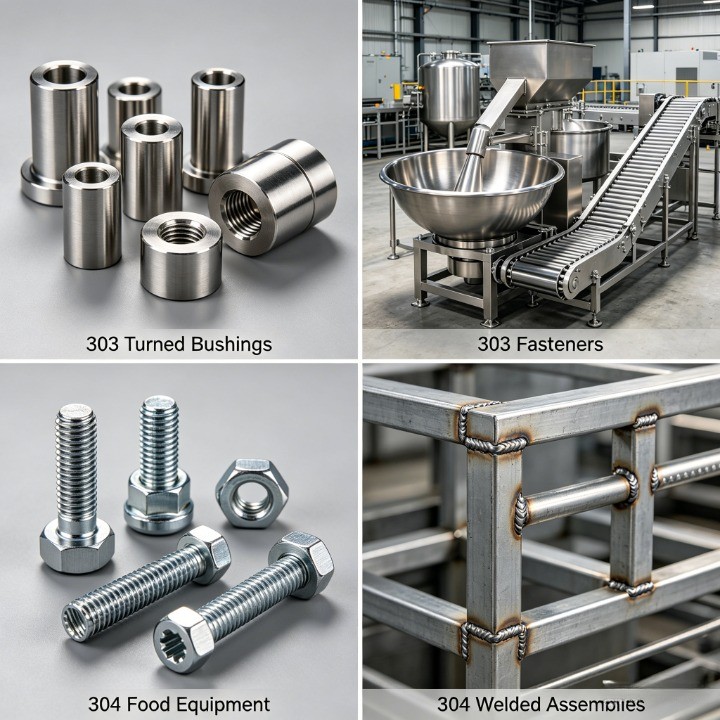
303 usually fits precision machined hardware. 304 usually fits general-purpose fabricated equipment.
This pattern stays consistent across most industrial applications because each grade was developed for a different priority.
Common Uses for 303 Stainless Steel
303 is commonly used for:
• precision shafts
• nuts and bolts
• threaded fittings
• bushings and spacers
• gears
• electrical hardware
• high-volume CNC turned parts
These applications benefit from easy machining, better chip control, and easier threading.
Common Uses for 304 Stainless Steel
304 is commonly used for:
• food processing equipment
• tanks and containers
• tubing and piping
• kitchen and sanitary hardware
• architectural trim and railings
• welded enclosures
• sheet metal assemblies
These applications benefit from stronger corrosion resistance, better weldability, and easier forming.
How to Choose by Application
If your part belongs to one of these groups, the grade choice becomes easier:
| Application Type | Better Choice | Reason |
|---|---|---|
| Precision turned shaft | 303 | Better machinability |
| Threaded custom fitting | 303 | Easier drilling and threading |
| Welded bracket | 304 | Better weldability |
| Food-contact enclosure | 304 | Better corrosion resistance |
| Outdoor housing | 304 | Better durability in moisture |
| Dry indoor machine spacer | 303 | Lower machining cost |
How Should Buyers Choose Between 303 and 304?
Buyers should choose based on manufacturing route and service environment, not on alloy familiarity.
That sounds simple, but it solves most mistakes.
Start with these questions:
- Is the part mostly machined from bar stock?
- Will the part be welded, bent, or stamped?
- Will the part be exposed to water, cleaners, or outdoor air?
- Is thread quality or chip control a major concern?
- Does the supplier stock the grade in the form you need?
If most of your answers point toward machining, 303 usually deserves serious consideration. If most of your answers point toward fabrication, corrosion resistance, or field durability, 304 is usually the better fit.
This method also improves quoting. When buyers define the process route clearly, suppliers can recommend the right grade earlier and avoid unnecessary back-and-forth later.
FAQ
Is 303 stainless steel magnetic?
303 is generally non-magnetic in annealed condition, just like 304. However, both grades can become slightly magnetic after cold work or heavy machining. For a broader explanation, see is stainless steel magnetic.
Is 303 stainless steel food grade?
304 is usually the safer and more widely accepted choice for food and beverage equipment. 303 is easier to machine, but its lower corrosion resistance makes it a weaker option for washdown and food-contact applications.
Can you weld 303 stainless steel?
Welding 303 is generally not recommended for critical assemblies. The sulfur that improves machinability also increases the risk of weld cracking and other weld-quality problems.
Is 304 always harder to machine than 303?
Yes, in most normal shop conditions 304 is harder to machine than 303. It tends to work-harden more easily and often requires more careful tool and feed control.
Should you choose 316 instead of 304?
If the part will face strong chloride exposure, marine conditions, or aggressive chemical washdown, 316 may be a better option than 304. That decision depends on the actual service environment.
Conclusion
303 is the better machining grade, while 304 is the better all-around corrosion and fabrication grade. If your part is mainly a bar-machined component used in a mild environment, 303 often lowers cycle time and improves production efficiency. If your part needs welding, forming, washdown resistance, or outdoor durability, 304 is usually the safer choice.
The best decision comes from matching the material to the real manufacturing route and service conditions. That approach helps you control both cost and long-term performance.
Talk with HMaking
At HMaking, we help you compare 303 vs 304 stainless steel based on machining route, corrosion exposure, weldability, and total production cost. Our team reviews your drawings from a manufacturing perspective, so you can choose the grade that fits both performance and budget. To speed up supplier evaluation, you can also review how to prepare RFQ files for fast, accurate quotes.
Contact us today and send your drawings or CAD files. We will review your part and recommend the most practical stainless steel option for your project.