


The answer depends on the grade — not all stainless steel behaves the same way around a magnet.
Some grades attract magnets strongly. Others show almost no response at all. And some grades that start as non-magnetic can develop a magnetic response after CNC machining, bending, or cold working.
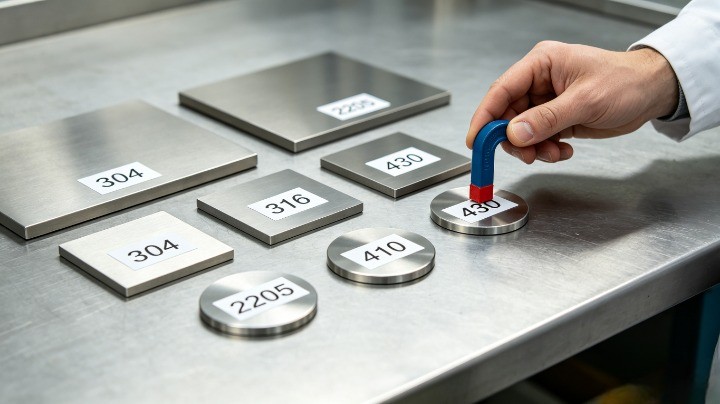
Which Stainless Steel Grades Are Magnetic?
| Stainless Steel Grade | Magnetic? | Crystal Structure | Relative Permeability (μr, typical) |
|---|---|---|---|
| 304 | No (annealed); slight after cold work | Austenitic | 1.0–1.05 (annealed); may rise after machining |
| 316 | No (annealed); minimal after cold work | Austenitic | ~1.0 (annealed) |
| 303 | No (annealed); similar to 304 | Austenitic | ~1.0–1.1 |
| 430 | Yes | Ferritic | 200–600 |
| 410 | Yes | Martensitic | 40–95 |
| 440C | Yes | Martensitic | 15–40 |
| 2205 | Moderately magnetic | Duplex | 2–5 |
| 17-4 PH | Yes (after aging) | Precipitation hardening | 40–110 (aged condition) |
Quick rule: Ferritic and martensitic grades are magnetic. Austenitic grades such as 304 and 316 are non-magnetic when annealed. Duplex and precipitation hardening grades are generally magnetic as well, though the response varies by structure and condition.
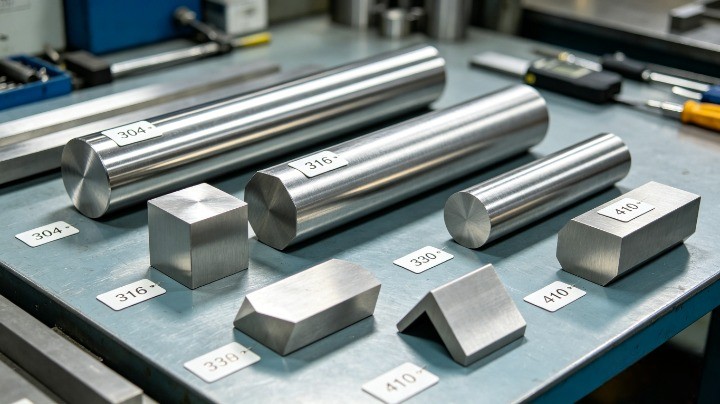
Why Does Crystal Structure Determine Magnetic Behavior?
Stainless steel is an iron-based alloy. Iron itself is ferromagnetic, but the magnetic behavior of the final alloy is determined mainly by its crystal structure, not by iron content alone.
Face-Centered Cubic (FCC) = Austenitic = Generally Non-Magnetic Grades such as 304 and 316 have an austenitic (FCC) crystal structure stabilized by nickel. Under normal conditions, this structure does not support strong ferromagnetic behavior, which is why these grades show near-zero magnetic response in the annealed state.
Body-Centered Cubic (BCC) = Ferritic = Magnetic Grades such as 430 have a ferritic (BCC) crystal structure, which allows strong magnetic domain formation. These grades attract magnets clearly.
Body-Centered Tetragonal (BCT) = Martensitic = Magnetic Grades such as 410 and 440C have a martensitic structure formed by rapid cooling. This structure is magnetic and also hard.
Does Stainless Steel Become Magnetic After Machining?
Yes — and this is one of the most common sources of confusion in incoming inspection.
When austenitic stainless steel such as 304 is subjected to:
-
CNC machining
-
Cold rolling
-
Bending
-
Stamping or deep drawing
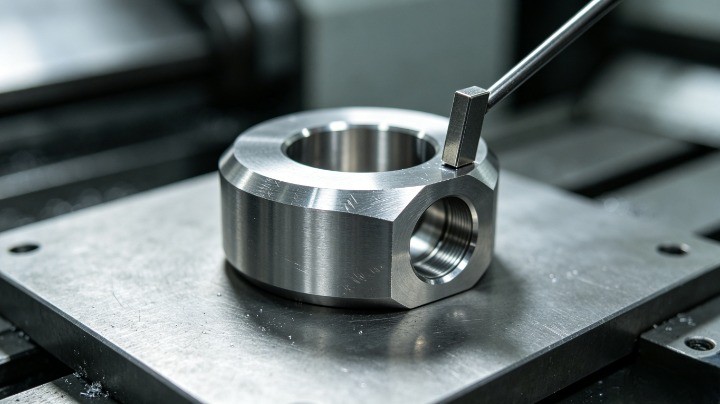
How much magnetic response is normal after machining?
In our machining experience with 304 stainless steel for industrial customers, finished parts often show slight magnetic response at stressed or freshly machined areas. As a shop-level reference, surface permeability can rise above the annealed baseline depending on the depth of cut, feed rate, tool geometry, and local deformation. This is expected and does not automatically indicate the wrong material.
For example, when we machined a series of 304 housings for an instrumentation customer, the finished parts showed weak magnet attraction at machined surfaces. Mill test reports (MTRs) confirmed the material was correct. The magnetic response came from surface-layer martensite created by machining stress. We resolved the concern by providing the MTR together with the CMM inspection report.
If near-zero magnetic response is critical for your application, specify 316 instead of 304. In our experience, 316 usually shows lower magnetic response after equivalent machining operations because its higher nickel content and molybdenum addition stabilize the austenitic structure more effectively. For a full comparison, see .
Magnetic Permeability Reference by Application
If your application has a magnetic sensitivity requirement, generic grade labeling is not enough. You should specify the actual magnetic permeability (μr) limit on your drawing or RFQ.
| Application Type | Typical μr Requirement | Recommended Grade |
|---|---|---|
| MRI room structural components | μr < 1.005 | 316L (vacuum annealed) |
| Scientific instrument housings | μr < 1.01 | 304 or 316 (annealed) |
| General industrial (no requirement) | Not specified | 304, 410, 430 (grade-dependent) |
| Food processing equipment | No strict magnetic requirement | 304, 316, 430 |
| Marine / chemical environments | No strict magnetic requirement | 316, 2205 |
Note: Achieving very low μr after fabrication may require controlled annealing after machining. Grade selection alone is not always enough.
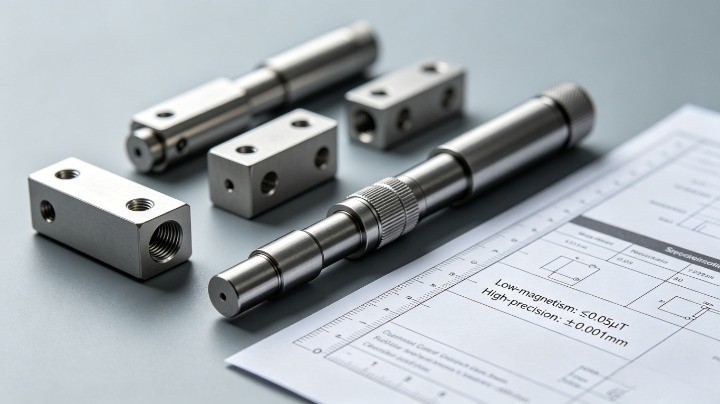
How to Verify Stainless Steel Grade When Magnetism Matters
A hand magnet test is useful only as a first-pass screen. It cannot:
-
Distinguish between 304 and 316
-
Confirm the heat number or chemical composition
-
Identify whether a part has been cold-worked or wrongly substituted
For applications where grade confirmation matters, use one or more of the following:
-
PMI (Positive Material Identification): handheld XRF or OES device that confirms elemental composition on-site or in the lab
-
XRF (X-Ray Fluorescence): identifies element ratios non-destructively and is useful for Cr, Ni, and Mo content
-
OES (Optical Emission Spectroscopy): lab-based and more precise for carbon and light elements
-
MTR (Mill Test Report): certifies the heat composition from the steel mill
At HMaking, we retain MTRs for all stainless steel stock and can provide them together with CMM inspection reports on request. For projects with specific magnetic requirements, we can also perform PMI verification before shipment.
You can review our quality control process and available inspection documentation on our .
A Practical Specification Checklist for Buyers
If magnetism matters in your project, your RFQ or drawing should specify:
-
Exact grade — such as 304, 316L, 410, or 430, not just “stainless steel”
-
Supply condition — annealed, cold-worked, hardened, or aged
-
Magnetic requirement — whether low magnetic response is required, and if so, the μr limit
-
Verification method — whether PMI, XRF, OES, or MTR documentation is required before shipment
-
Post-processing requirement — whether post-machining annealing is required for critical magnetic performance
Including these details reduces inspection disputes and eliminates the most common material substitution issues. You can also use this to make sure your files include all grade and inspection requirements before sending them to suppliers.
FAQs About Stainless Steel Magnetism
Can magnets stick to stainless steel?
Yes, depending on the grade. Ferritic grades such as 430 and martensitic grades such as 410 attract magnets strongly. Austenitic grades such as 304 and 316 are generally non-magnetic when annealed, though slight magnetism can develop after cold working or machining.
Why does 304 stainless steel sometimes attract a magnet after machining?
304 contains a metastable austenitic structure. Cold work — including CNC machining, bending, and stamping — can trigger strain-induced martensitic transformation (SIMT), creating a partially magnetic surface layer. This is normal and does not mean the wrong material was used. For more on this grade, see .
Is 316 stainless steel completely non-magnetic?
316 is generally non-magnetic when annealed. Its higher nickel content and molybdenum addition give it a more stable austenitic structure than 304, so it usually shows less magnetism after machining. However, severe deformation can still induce slight magnetic response.
What is the magnetic permeability of 304 stainless steel?
Annealed 304 typically has μr close to 1.0 to 1.05, which is essentially non-magnetic in practical terms. After cold working or machining, μr can rise depending on the degree of deformation and surface stress.
Is food-grade stainless steel magnetic?
Most food-grade applications use 304 or 316, which are non-magnetic in the annealed condition. Grade 430 is also used in some food-contact applications such as cookware and kitchen equipment, and it is magnetic.
Can you use a magnet to identify stainless steel grade?
Only as a rough first check. A magnet can help distinguish ferritic or martensitic grades from austenitic grades, but it cannot differentiate 304 from 316 or confirm exact composition. Use PMI, XRF, or MTR documentation when grade confirmation is required.
Conclusion
Stainless steel can be magnetic or non-magnetic — the answer comes down to the grade and its crystal structure.
Ferritic grades such as 430 and 409, and martensitic grades such as 410 and 440C, are magnetic. Austenitic grades such as 304 and 316 are non-magnetic when annealed, but can develop partial magnetism after machining because of strain-induced martensite. Duplex and precipitation hardening grades are also generally magnetic.
For engineering and procurement decisions, a hand magnet test is a useful starting point, but it should not replace proper material verification — especially for applications with strict magnetic performance requirements.
At HMaking, we machine stainless steel components in 304, 316, 410, 430, and other grades for industrial customers who require reliable material traceability, dimensional accuracy, and documented quality inspection. If you need help selecting the right grade, comparing , or verifying material for a specific application,