


Inconel and titanium solve very different problems in demanding engineered parts.
Choosing the wrong one can add unnecessary weight, raise machining costs, or leave the part unable to handle heat in service. Titanium is valued for low density, high specific strength, and marine corrosion resistance, while Inconel is selected for strength retention and oxidation resistance at much higher temperatures.
This guide compares Inconel 718 and Ti-6Al-4V in weight, strength, heat resistance, stiffness, and machining, so you can choose the material that fits your application more confidently.
Quick Answer
-
Choose Inconel 718 when the part needs to retain immense strength at elevated temperatures, resist thermal oxidation, and survive demanding gas turbine, exhaust, rocket, or cryogenic-to-hot service conditions.
-
Choose Titanium Ti-6Al-4V when the part needs to be significantly lighter, maintain a superior strength-to-weight ratio, and resist seawater or chloride attack in a lower-temperature service range.
Inconel vs Titanium at a Glance
Based on commercial material data from industry leaders like Special Metals and TIMET.
| Factor | Inconel 718 | Titanium (Ti-6Al-4V) |
|---|---|---|
| Material Family | Nickel-based superalloy | Alpha-beta titanium alloy |
| Density | ~8.19 g/cm³ (Much Heavier) | 4.42 g/cm³ (Much Lighter) |
| Strength Focus | High absolute strength (especially when hot) | High specific strength (strength-to-weight) |
| Max Sustained Service Temp | ~1300°F – 1400°F (760°C) | ~660°F (350°C) |
| Oxidation Resistance | Exceptional hot-oxidation capability | Lower hot-service limit |
| Seawater / Chlorides | Good, but not the default choice | Unmatched general resistance |
| Stiffness (Young’s Modulus) | ~200 GPa (Highly rigid) | ~107–122 GPa (More flexible) |
| CNC Machining | Extremely difficult (Rapid work-hardening) | Difficult (Low thermal conductivity) |
The Core Difference: Chemistry and Design Intent
The biggest difference between these two alloys is what they are optimized to survive.
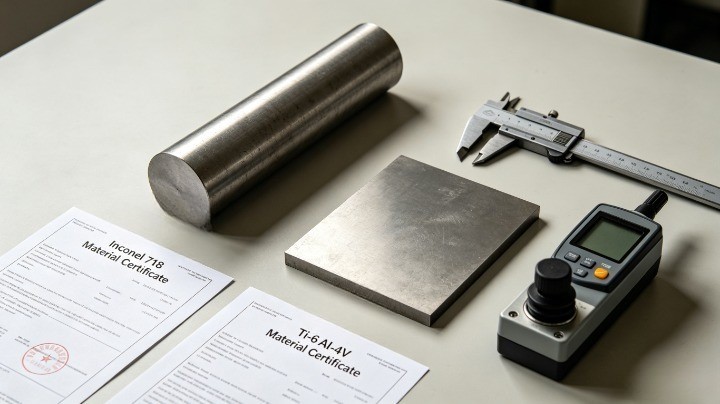
Inconel 718 is a nickel-chromium superalloy (roughly 54% Nickel, 18% Chromium, plus Iron, Niobium, and Molybdenum). It is specifically designed to prevent creep and maintain tensile strength at glowing-hot temperatures.
Ti-6Al-4V is alloyed with 6% Aluminum and 4% Vanadium. It is engineered to strip away as much mass as possible while retaining structural integrity and fending off corrosive attacks at room to moderate temperatures.
Deep Dive: The 4 Key Engineering Differences
1. Weight and Density: Titanium is Half the Weight
Titanium is dramatically lighter. At 4.42 g/cm³, titanium is nearly half the weight of Inconel 718 (8.19 g/cm³).
In simple terms, an Inconel part and a titanium part with the exact same CAD geometry will not feel remotely similar in your hand; the Inconel part will be heavily dense, akin to stainless steel. This is why titanium remains the holy grail for , lightweight fasteners, and high-value moving assemblies where shedding grams translates directly into fuel savings or payload capacity.
2. Strength: Load vs. Weight
Inconel 718 is usually the better choice when the part must handle high load at elevated temperature. Ti-6Al-4V is also strong, but its main advantage is its strength-to-weight ratio. In simple terms, titanium gives you more strength for less weight, while Inconel gives you better strength when heat is part of the job.
3. Heat Resistance
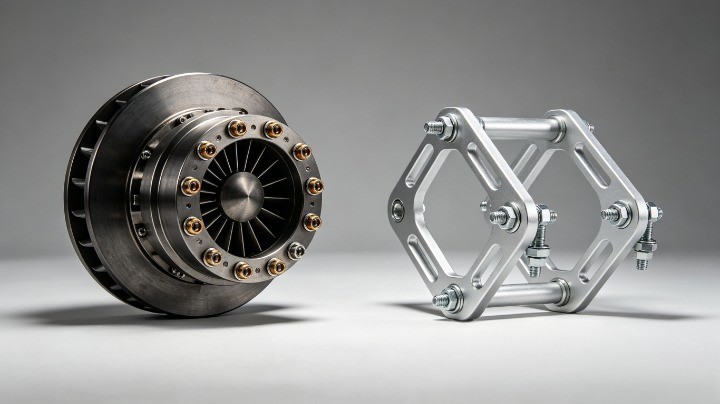
This is where the gap becomes clear. Inconel 718 can work from cryogenic temperatures up to about 1300°F, while Ti-6Al-4V is generally limited to around 660°F (350°C). If the part will see sustained heat, Inconel is usually the more suitable material.
4. Stiffness
Titanium is lighter, but it is not stiffer. Ti-6Al-4V has a modulus of about 110 GPa, while Inconel 718 is around 200 GPa. Under the same load, a titanium part will deflect more. If rigidity matters more than weight, Inconel may be the better choice.
Machining Reality on the Shop Floor
For buyers, understanding how these metals machine dictates your unit cost. Both are notorious tooling-killers, but for different reasons, which is why machining strategy has a direct effect on .
Machining Inconel
is notoriously difficult because nickel alloys suffer from extreme work hardening. If a CNC cutting tool rubs against Inconel instead of cleanly slicing it, the surface instantly hardens, destroying the tool insert on the next pass. It requires incredibly rigid machines, massive torque, and slow, deliberate cuts.
Machining Titanium
presents a different challenge. Titanium’s biggest flaw is its poor thermal conductivity. The heat from cutting doesn’t leave with the metal chip; it transfers directly into the cutting tool, causing it to overheat and fail. Titanium is also chemically reactive and prone to galling, meaning it can weld itself to the tool.
Typical Applications
Where to Use Inconel 718
-
Gas turbine rings, blades, and casings
-
Rocket engine hot-section hardware
-
High-temperature exhaust fasteners and manifolds
-
Cryogenic-to-hot-service fluid valves
-
Nuclear reactor components
Where to Use Titanium (Ti-6Al-4V)
-
Lightweight aerospace airframes and landing gear components
-
Deep-sea submersibles and marine pump housings
-
High-pressure vessels and lightweight performance fasteners
-

FAQ
Is Inconel stronger than titanium?
In absolute terms and at elevated temperatures, yes. Inconel 718 handles vastly higher physical loads. However, titanium offers a much better strength-to-weight ratio because it is nearly 50% lighter.
Which is better for seawater, Inconel or titanium?
While Inconel is highly corrosion-resistant, titanium is the undisputed winner for seawater and neutral chloride exposure. Titanium is virtually immune to marine environments.
Is Inconel stiffer than titanium?
Yes. Inconel 718 has a Young’s Modulus of around 200 GPa, making it nearly twice as rigid as titanium (~110 GPa) under load.
Which is harder to CNC machine?
Both command premium machining rates. Inconel requires strict management of work-hardening, while titanium requires strict management of heat accumulation and tool galling.
Choosing Between Inconel and Titanium
The better material depends on what the part must survive. Inconel 718 is usually the right choice for high-temperature service, oxidation resistance, and strength under heat. Ti-6Al-4V makes more sense when low weight, corrosion resistance, and high strength-to-weight ratio matter more. Instead of comparing them as direct substitutes, match the alloy to the service environment, load condition, and manufacturing priorities. That usually leads to a more practical and reliable decision.
Discuss Your Project with HMaking
At HMaking, we help you compare Inconel and titanium based on real part requirements, machining difficulty, service conditions, and cost. Our team reviews your drawings with manufacturability in mind, so you can make a clearer material choice before production.