


Yes, nickel is magnetic.
Since it exhibits significant magnetic features, it is classified as a ferromagnetic material. Commonly ferromagnetic at normal temperatures, nickel can attract and might become magnetized on its own self.
At the Curie temperature, above 358°C (676°F), is the point at which nickel loses its ferromagnetic capabilities and turns paramagnetic. Due to its magnetic features nickel is utilized in the manufacturing of magnets, electrical components, and in aircraft sectors.

Advantages of Nickel Magnetism
Cost-effective and Available
When contrasted with other uncommon rare-earth metals employed in sturdy magnets, nickel is a comparatively inexpensive and readily available metal. Given this, you will find that magnetic materials composed of nickel are economical for several purposes.
Ecological Benefits
Unlike magnets made of less environmentally friendly materials, nickel magnets possess less effect on the environment because of their effective reuse and recycling.
Features of Ferromagnet
Nickel is a ferromagnetic material. Therefore, despite the absence of a magnetic field from outside, it might become extremely magnetized while maintaining its magnetic qualities.
Nickel is ideal for utilization in permanent magnets as a result of its unique properties.
Strong Magnetic Permeability
A substance’s capability to get magnetized in the presence of a magnetic field from another source is described as its permeability to magnets.
Nickel happens to exhibit an exceptional level of this characteristic.
Due to this feature, nickel can be utilized in applications like transformers and magnetic shielding which demand materials with a substantial permeability.
Best for Alloying to make Magnets
Nickel’s alloying abilities enable it to be alloyed with other components including cobalt, iron, and aluminum, and simplicity to generate magnetic alloys with particular features. Magnetic components with greater efficiency include alloys such as Permalloy (iron and nickel) and Alnico (aluminum, nickel, and cobalt).
Curie Temperature Management
Through combining with other components, nickel’s Curie temperature ( where it loses its ferromagnetic capability) may be modified.
Due to this, nickel alloys might have their magnetic properties adjusted to a particular temperature spectrum, which renders them suitable for a range of applications.
Resilience to Corrosion
Nickel is popular for its ability to resist corrosion, which is beneficial in circumstances where exposure to adverse conditions is an issue. Magnetic substances that are resilient to corrosion are vital in fields including aircraft and maritime.
Magnetic Consistency
Gradually, nickel magnets—especially the ones used in alloys—offer remarkable magnetic stability. Maintaining the functionality of magnetic systems and equipment relies on this stability.
Versatility in Uses
Nickel is employed in an array of fields, like telecommunications, electronics, energy, and automotive, thanks to its magnetic features. Magnetic sensors, permanent magnets, magnetic shielding, and other devices are produced from it.
Comparing Nickel Magnetism Properties with Other Metals
Magnetism of Nickel vs Iron
Since nickel is a ferromagnetic metal, it can become magnetized and remain magnetized even without the presence of an external magnetic field.
Iron, on the contrary, is a ferromagnetic metal that has a greater magnetic susceptibility than nickel. This implies that when compared to nickel, iron may be magnetized much easier and possesses a greater magnetic reaction.
Magnetism of Nickel vs Cobalt
Similar to iron, cobalt is also a ferromagnetic metal that has substantial magnetism. The point at which a ferromagnetic material loses its magnetism is described as the Curie temperature, and nickel exhibits an elevated one compared to cobalt. Due to this, nickel is a more appropriate option for situations necessitating magnetism at greater temperatures.
Magnetism of Nickel vs Titanium
Unlike Nickel, titanium is not a ferromagnetic metal. It is categorized as paramagnetic, which signifies that since it cannot maintain magnetism on its own, it is weakly drawn to magnetic fields. Thus, as contrasted with titanium, nickel has a more powerful magnetic reaction.

History of Nickel
Axel Fredrik Cronstedt found nickel in 1751, and Chinese coins were probably the first to make use of it. Named right after “kupfernickel,” indicating “Devil’s copper,” nickel served an important part in nickel silver alloys during the 19th century. Industrial development expanded the strategic value of the creation of stainless-steel during World War II.
A while later, it affected the electronics, chemical, and electroplating fields. Batteries for electric automobiles are some of the modern uses that promote environmentally friendly technology.
The transition of nickel from an unidentified metal to an adaptable component affecting an extensive variety of sectors is reflected in its history.
Is Nickel Ferromagnetic?
Yes, nickel is ferromagnetic. Nickel possesses this characteristic described as ferromagnetism in which the direction of the atoms’ moments of magnetism aligns to produce a powerful overall magnetic effect.
When you subjected it to a magnetic field from outside, this alignment helps the material to become greatly magnetized and to keep its magnetization even when the external field gets eliminated.
Nickel is one of the typical examples of a ferromagnetic substance, together with iron and cobalt. Nickel is normally ferromagnetic at ambient temperatures and attracts magnets.
It’s critical to keep in mind that nickel’s ferromagnetic capabilities deteriorate while increasing the temperature. At its Curie temperature of above 358°C (676°F), nickel loses these features and turns non-magnetic.
Applications of Nickel Magnetism
Permanent Magnets: Sturdy permanent magnets with particular magnetic features are created from alloys like Alnico (aluminum, nickel, cobalt).
Generators and Electric Motors: To transform electrical energy into mechanical energy, magnets comprising nickel are crucial.
Magnetic Sensors: Electronic gadgets and automotive components greatly depend on nickel alloys, that involve Hall effect sensors.
Magnetic Shielding: Highly permeable nickel alloys offer magnetic shielding to safeguard delicate devices from magnetic disturbance.
Electromagnetic Coils: The effectiveness of coils in transformers and inductors is boosted by nickel.
Recording Media: For the storage of data on magnetic disks and hard drives, nickel is critically important.
MRI machines: Parts of medical imaging instruments are made of alloys comprising nickel to guarantee efficient operation.
Automotive Technology: Electric power steering and engine systems utilize nickel magnets.
Speaker Systems: Alnico alloys assist speakers and audio equipment’s magnetic fields become more productive.
Electroplating: Nickel is utilized in electroplating procedures to generate decorative and protective coatings.
Properties of Nickel
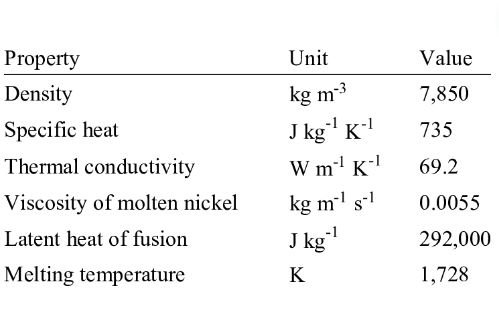
The physical properties of nickel are as follows:
- Atomic number: 28
- Atomic mass: 58.69 g/mol
- Melting point: 2647 °F, or 1453 °C.
- Boiling point: 5275 °F [2913 °C]
- Density: 0.32 lbs/in³ (8.90 g/cm3)
- Appearance: Bright, silver-white metal.
- Crystal Structure: Face-centered cubic crystal lattice (fcc).
- Ductile and Flexible: Simple to form and coil into wires and sheets.
- Great Thermal and Electrical Conductor: excellent in several electrical parts and heat exchangers.
- Resilience to Corrosion: Nickel resists corrosion effectively, particularly in circumstances that are declining. On its surface, it generates a covering of protective oxide.
- Alloying Capability: Nickel easily creates alloys with numerous other components, letting it create a broad spectrum of specialty materials.
- High Temperature Resistance: At extreme temperatures, nickel maintains its integrity and stability.
- Magnetic Features: At room temperature, ferromagnetic. Above the Curie temperature, which is 358°C (676°F), it then loses its ferromagnetism.
Factors Impacting Nickel Magnetic Properties
· Alloying Components
The magnetic features of nickel may be greatly influenced by the inclusion of other components. Some nickel alloys, for instance, including Permalloy (iron, nickel) and Alnico (aluminum, nickel, cobalt), are intended to exhibit particular magnetic features.
· Impurities
The magnetic qualities of nickel may be degraded or even entirely removed by tiny amounts of contaminants such as chromium or manganese. Its magnetic behavior’s intensity and reliability are highly reliant on its purity.
· Grain Size
The magnetic features of a substance might be impacted by the size as well as the orientation of its nickel granules. Greater and more dependable magnetism tends to be the result of smaller and more even granules.
· Magnetic Fields
Nickel’s magnetic properties may be impacted by external magnetic fields. Magnetization takes place when the fields of magnetism in nickel align in the existence of a magnetic field. This alignment is influenced by the external field’s direction and strength.
· Strain and Imperfections
The magnetism of nickel might be compromised by strain, mechanical stress, or the existence of flaws in the nickel structure. For exceptional magnetic efficiency, the structure needs to be kept free of stress and imperfections.
· Temperature
Nickel turns paramagnetic and loses its ferromagnetism at Curie temperature beyond 358°C (676°F). This shows that it has decreased its capability to maintain magnetism and cannot continue exhibiting its unique attraction to magnets.
In circumstances where temperature variations are involved, being aware of the Curie temperature is essential.
· Heat treatment and Manufacturing
Nickel’s magnetic features are impacted by the procedures employed in its production and heat treatment. The magnetic attraction and crystal structure are customizable through annealing along with other heat treatments.
Is Nickel Used in Permanent Magnets?
Truly, nickel is an essential element of permanent magnets, however, it is not the only element employed in magnets.
Since it is not strong enough by itself, it combines with cobalt and iron to generate magnets that are powerful like neodymium and alnico. Consider nickel as the magnetic facilitator that improves the team’s strength and consistency.
Given its magnetic characteristics, nickel has significance for an array of uses, such as generators, electric motors, magnetic sensors, and medical supplies.
Nikel’s Magnetism in Various Alloys
Alnico (Aluminum, Nickel, Cobalt):
- Alnico alloys are often employed in magnets and are composed of nickel, aluminum, and cobalt.
- Powerful magnetization represents one of the ferromagnetic characteristics that nickel contributes to.
Permalloy (Iron, Nickel):
- Alloys such as iron and nickel are popular for possessing an excellent permeability to magnetism.
- Since nickel improves magnetic features, Permalloy is commonly utilized in magnetic shielding and transformer operations.
Non-magnetic Nature and Diamagnetic Properties of Nickel
Although it is normally ferromagnetic, nickel might also be diamagnetic. It repels a weak magnetic field weakly at normal temperature. At elevated temperatures, this diamagnetic action increases, strengthening its mainly ferromagnetic properties.
Nickel truly possesses ferromagnetic features, indicating that it is magnetic. Its importance in a wide range of industries in need of magnetism is demonstrated by its powerful attraction to magnets and alloying abilities, exhibited in Alnico. Note that the magnetic features of nickel differ based on variables like temperature.
You can see many factors that affect the nickel magnetism properties. Quite frankly, nickel plays an integral role in magnetism since it forms an alloy in many magnets.
More Resources:
Ferromagnetism – Source: BRITANNICA
Is Copper Magnetic – Source: HM
Nickel Magnetism – Source: UMD
Is Steel Magnetic – Source; HM
Magnetic Metals Guide – Source: ECLIPSE MAGNETICS
ALNICO MAGNETS – Source: WIKIPEDIA