


Many engineers, buyers, and inspectors still rely on a simple magnet test to judge metals. When copper does not stick, doubts appear. Is the material pure copper, an alloy, or something else? In manufacturing, electrical design, and quality inspection, this confusion can lead to wrong assumptions, rejected parts, or poor material choices.
This guide explains how copper actually behaves around magnets, why it matters in real applications, and how to interpret copper’s magnetic behavior with confidence from an industrial manufacturing and engineering perspective.
Understanding Copper and Magnetism
What Does It Mean for Copper to Be Magnetic?
Copper is not magnetic in the everyday sense. A standard magnet will not stick to copper, and copper will not attract or repel magnets the way iron or steel does. In material science, this means copper is not ferromagnetic, which is the type of magnetism most people recognize.
However, “magnetic” does not always mean attraction. Some materials interact with magnetic fields without sticking to a magnet. Copper falls into this category. It responds weakly to magnetic fields under specific conditions, especially when the field changes or moves. This distinction explains why copper behaves differently in motors, generators, and electromagnetic systems.

The Science Behind Copper’s Lack of Magnetism
From a physics perspective, copper is classified as a diamagnetic material. Its electrons pair up completely, so their magnetic moments cancel each other out. As a result, copper does not form magnetic domains, which are required for strong magnetism.
When a magnetic field is present, copper generates a very weak opposing field. This effect is real but extremely small. You cannot feel it with a handheld magnet, but engineers observe it in controlled environments. According to published material data from Wikipedia – Magnetism and standard physics references, copper’s magnetic permeability is slightly lower than vacuum, confirming its non-magnetic nature.
In industrial manufacturing and electrical components, this predictable behavior is a major advantage. Copper will not interfere with magnetic sensors, permanent magnets, or precision electromagnetic systems.
Why Is Copper Non-Magnetic?
Copper’s Atomic Structure and Electron Configuration
Copper is non-magnetic because of how its electrons are arranged. Each copper atom has fully paired electrons in its outer shells. Paired electrons cancel out each other’s magnetic moments, so no net magnetism remains. Without unpaired electrons, copper cannot form magnetic domains. This predictable non-magnetic behavior is one reason copper is widely used in precision CNC metal parts for electrical and industrial applications
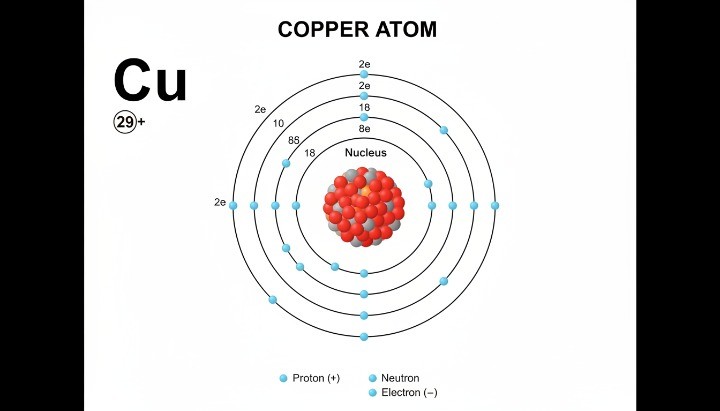
From an engineering perspective, this matters more than theory. Materials with unpaired electrons can align under a magnetic field and stay magnetized. Copper cannot. Even under strong fields, copper returns to a neutral state as soon as the field disappears. This stable behavior makes copper reliable in precision electrical and mechanical systems.
According to published physical constants summarized by Wikipedia – Magnetic susceptibility, copper shows weak diamagnetism, with no practical attraction to magnets.
Differences Between Copper and Magnetic Metals (Iron, Nickel)
Iron and nickel behave differently because their atomic structures allow unpaired electrons. These electrons align into magnetic domains, which create strong attraction to magnets. Once aligned, these domains can remain stable, forming permanent magnetism.
Copper lacks this domain structure entirely. No alignment occurs, and no residual magnetism remains. This difference explains why a magnet sticks firmly to steel but slides off copper instantly.
In industrial manufacturing, this contrast helps with material identification. A quick magnet test separates ferrous metals from copper-based materials. However, alloys may complicate results, which requires deeper inspection methods.
Can Copper Be Made Magnetic?
Magnetic Behavior in Copper Under Specific Conditions
Copper cannot become permanently magnetic. However, copper can interact with magnetic fields when conditions change. When a magnet moves near copper, electrical currents form inside the metal. These currents create their own magnetic fields that oppose the motion.

This effect, known as electromagnetic induction, explains why a magnet falls slowly through a copper pipe. The magnet does not stick, but copper clearly reacts. Engineers use this predictable response in braking systems, sensors, and energy dissipation designs.
Importantly, once the magnetic field stops moving, copper returns to a non-magnetic state immediately.
Copper Alloys and Magnetism
Pure copper remains non-magnetic, but some copper alloys behave differently. When alloying elements such as iron or nickel enter the structure, the material may show weak magnetic response. Brass and bronze usually remain non-magnetic, while specialty copper alloys may not. This is why many industrial applications rely on well-defined brass parts and copper alloys where magnetic behavior must remain predictable.
This matters in procurement and quality control. A weak magnetic response does not automatically mean low copper content. Alloy composition, heat treatment, and impurities all affect results. Material certificates and chemical analysis provide more reliable confirmation than magnet tests alone.
Practical Applications of Copper’s Magnetic Behavior
Engineers use copper’s predictable response to magnetic fields in practical ways:
-
Eddy current braking systems
-
Induction heating equipment
-
Magnetic damping mechanisms
-
Non-contact speed and position sensors
These applications rely on copper reacting to changing fields, not permanent magnetism. This distinction prevents design errors and improves system reliability.
Real-World Applications of Copper’s Non-Magnetic Properties
Copper in Electrical Wiring and Power Distribution
Copper dominates electrical wiring because it combines high conductivity with non-magnetic behavior. Magnetic materials distort electric fields and increase losses. Copper avoids this problem.

In power distribution systems, copper minimizes heat buildup and electromagnetic interference. According to the International Copper Association, copper carries over 90% of global electrical transmission due to these properties.
In CNC-machined electrical components, copper also maintains dimensional stability near magnetic fields, which protects connection accuracy.
Copper in Electronics and Communication Equipment
Modern electronics rely on clean signals. Magnetic interference degrades signal quality. Copper helps prevent that risk.
Printed circuit boards, connectors, and shielding layers use copper because it does not distort magnetic fields. At the same time, it supports stable current flow. This is why many engineers specify CNC electronic components built around copper conductors and structures for sensitive electronic systems.

Copper in Motors, Generators, and Transformers
Electric motors and generators depend on controlled magnetic fields. Copper plays a supporting role without interfering.
Copper windings carry current while magnetic cores handle flux. If copper were magnetic, efficiency would drop. Losses would rise. Heat would increase. Copper’s neutrality keeps magnetic circuits predictable and efficient.
This separation of roles explains why copper and steel work together in almost every electric machine.

Copper in Medical Devices and MRI Technology
Medical imaging demands strict magnetic control. MRI systems generate extremely strong magnetic fields. Any magnetic material near the scanner becomes a safety risk.
Copper remains safe and stable in these environments. Medical equipment, grounding systems, and shielding components rely on copper to avoid field distortion. This is why non-magnetic CNC medical parts manufactured from copper and copper alloys are widely used in MRI-related and sensitive medical applications. Hospitals depend on this behavior to maintain accuracy and patient safety.

Unique Aspects of Copper’s Interaction with Magnetism
Why Copper Doesn’t Stick to Magnets
Copper does not stick to magnets because it lacks magnetic domains. No alignment occurs, so attraction never develops. This simple fact explains most everyday observations.

The Role of Copper in Magnetic Shielding and EMI Protection
Copper does not block magnetic fields directly, but it shields against electromagnetic interference by redirecting induced currents. This principle supports Faraday cages, cable shielding, and grounded enclosures.
In industrial environments, copper shielding protects sensitive electronics from noise generated by motors, transformers, and switching equipment. Standards referenced by IEC electromagnetic compatibility guidelines recognize copper as a preferred shielding material.

Copper’s Role in Renewable Energy Systems
Renewable energy systems rely on efficient electromagnetic control. Wind turbines, solar inverters, and energy storage systems all use copper extensively.
Copper’s non-magnetic nature ensures predictable field behavior. At the same time, its conductivity supports high-efficiency power transfer. This combination improves reliability and reduces maintenance across renewable installations.

The Future of Copper and Magnetism
Copper’s Potential in Emerging Technologies
Emerging technologies continue to push electromagnetic precision. Electric vehicles, advanced sensors, and power electronics demand materials that behave consistently near magnetic fields.
Copper already meets these demands. Engineers continue to optimize copper geometries and alloys to reduce losses and improve thermal performance, not magnetism. The focus remains on control, not attraction.
Copper and Its Role in Modern Manufacturing
From an industrial manufacturing perspective, copper remains essential. CNC machining, precision forming, and electrical assembly all depend on its stable physical behavior.

As systems grow more complex, material predictability becomes more valuable. Copper’s non-magnetic nature removes variables from design and production. That reliability explains why copper remains irreplaceable across modern industries.
FAQs
Does Copper Stick to a Magnet?
No, copper does not stick to a magnet. Pure copper is a non-magnetic metal, so you will not see attraction in a normal magnet test. This is why copper belongs to the non-ferrous category in manufacturing and recycling.
If a magnet sticks to a copper-colored part, the material is almost never pure copper. In practice, this usually means copper-plated steel, a hidden ferrous insert, or mixed materials in an assembly. From a quality and sourcing perspective, a magnet test helps you screen out obvious mistakes, but it does not confirm copper purity on its own.
Can Copper Be Magnetized?
Copper cannot be magnetized into a permanent magnet. It does not hold magnetic domains like iron or nickel, so it will not stay magnetic after a field is removed.
However, copper can interact strongly with changing or moving magnetic fields. Eddy currents form inside the copper and create opposing magnetic fields. This effect explains why a magnet slows down inside a copper tube. The behavior comes from electrical conductivity, not permanent magnetism. In engineering terms, copper remains non-magnetic but electromagnetically active.
What Are Copper Alloys and Their Magnetic Properties?
Most common copper alloys, such as brass and bronze, remain non-magnetic. Their base behavior stays similar to pure copper because copper still dominates the structure.
Magnetic response appears only when alloys include ferromagnetic elements like iron or certain nickel combinations, or when parts include steel inserts or contamination. This is why some “copper alloy” parts trigger confusion during inspection. When magnetic behavior matters for safety or performance, material verification methods like XRF provide clarity beyond simple magnet checks.
Can Copper Increase the Strength of a Magnet?
No, copper does not increase magnetic strength. Copper does not amplify or concentrate magnetic fields the way ferromagnetic materials do.
What copper can do is influence how magnetic fields behave in motion. Induced currents can slow movement, damp vibration, or reduce electromagnetic noise. Engineers use these effects in braking, shielding, and EMI control. Copper shapes electromagnetic systems indirectly, but it does not make magnets stronger.
Conclusion
Summary of Copper’s Magnetic Properties
Copper is not magnetic in the practical sense. A magnet will not stick to copper, and copper cannot become a permanent magnet. Its atomic structure prevents strong magnetic alignment, while its high conductivity allows interaction with changing magnetic fields through induction. This combination explains both the confusion and the usefulness of copper around magnetism.
Why Copper Is Still Irreplaceable in Modern Industries
Copper remains essential because it delivers predictable electrical performance without unwanted magnetic interference. In electrical systems, electronics, motors, medical devices, and renewable energy, copper supports current flow, thermal control, and EMI management. From an engineering and manufacturing perspective, copper’s non-magnetic nature is not a limitation—it is a critical advantage. If your application requires non-magnetic copper or copper-alloy components with reliable machining quality, you can request a quote for custom metal parts based on your drawings and specifications.