


Choosing between 17-4PH and 316 stainless steel depends on what your part must withstand.
A wrong material choice can create strength limitations, corrosion problems, fabrication difficulties, or unnecessary cost. 17-4PH is commonly used when high strength and hardness are the priority, while 316 is preferred when corrosion resistance, weldability, and long-term durability in harsh environments matter more.
This guide explains the key differences between 17-4PH and 316 stainless steel, so you can select the right grade for machining, fabrication, service conditions, and overall project performance.

Quick Answer
-
Choose 17-4PH when the part requires exceptionally high yield strength, surface hardness, and dimensional stability after heat treatment. It is the premier choice for heavy-duty pump shafts, valve stems, gears, aerospace fasteners, and high-stress machined components.
-
Choose 316 when the part needs best-in-class resistance to pitting and crevice corrosion, or requires extensive bending and welding. It guarantees dependable service in food processing, marine-adjacent environments, chemical tanks, and architectural equipment.
17-4PH vs 316 Stainless at a Glance
The comparison below uses 17-4PH in its common aged conditions (precipitation hardened) and 316 in the annealed condition, reflecting how these grades are actually specified on the shop floor.
| Factor | 17-4PH Stainless (Type 630 / S17400) | 316 Stainless (S31600) |
|---|---|---|
| Stainless Family | Precipitation-hardening martensitic | Austenitic (Molybdenum-bearing) |
| Heat Treatable? | Yes (Age hardening) | No (Cold work only) |
| Typical Yield Strength | ~725–1170 MPa (Depending on aging) | 205 MPa minimum |
| Typical Tensile Strength | ~930–1310 MPa (Depending on aging) | 515 MPa minimum |
| Hardness | Up to ~40 HRC (in H900 condition) | Up to ~95 HRB / 217 HB |
| Corrosion Resistance | Moderate to good (Comparable to 304) | Excellent (Strong resistance to chlorides) |
| Weldability | Good, but requires post-weld heat treatment | Excellent |
| Formability | Mild forming only | Highly formable (Readily bent/rolled) |
| Typical Use | Shafts, gears, high-load bolts, engine parts | Food equipment, chemical tanks, marine fittings |
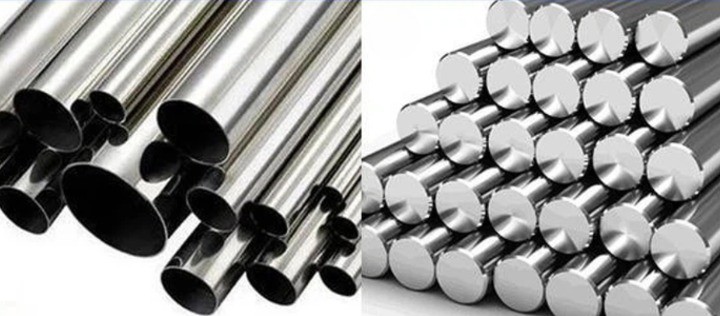
What Is the Main Difference?
The fundamental difference lies in the metallurgical design goals behind each alloy.
17-4PH is a chromium-nickel-copper precipitation-hardening stainless steel. The addition of Copper (Cu) and Niobium/Columbium (Nb) allows the metal to be hardened via a low-temperature aging process, delivering aerospace-grade strength.
316 is an austenitic stainless steel built around a heavy dose of Nickel (10-14%) and the critical addition of Molybdenum (2-3%). This molybdenum content is exactly what gives 316 its legendary resistance to chloride pitting and crevice corrosion.
Chemical Composition Comparison
| Element | 17-4PH Stainless | 316 Stainless |
|---|---|---|
| Chromium (Cr) | 15.0–17.5% | 16.0–18.0% |
| Nickel (Ni) | 3.0–5.0% | 10.0–14.0% |
| Copper (Cu) | 3.0–5.0% | — |
| Niobium (Nb) | 0.15–0.45% | — |
| Molybdenum (Mo) | — | 2.0–3.0% |
Strength and Hardness: 17-4PH Is in a Different Class
This is where 17-4PH separates itself most aggressively from 316.
17-4PH is not just “a little stronger”—it is in an entirely different strength class. In its peak-aged H900 condition, 17-4PH can achieve a yield strength of roughly 1170 MPa. By comparison, annealed 316 guarantees a minimum yield strength of just 205 MPa. This means 17-4PH can handle nearly 4 to 5 times the mechanical load before permanently deforming.
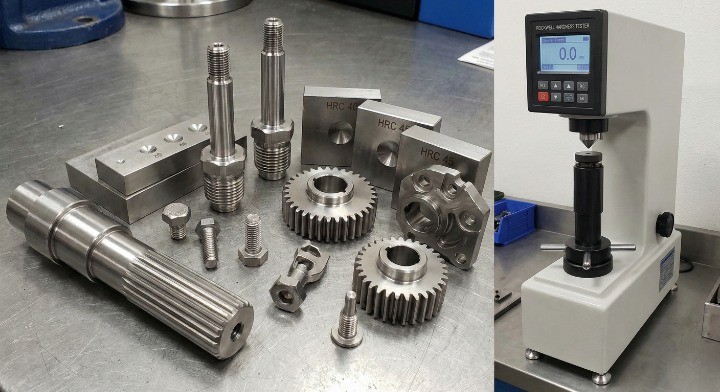
Hardness tells the exact same story. 17-4PH can easily reach 40 HRC, making it highly wear-resistant. 316 tops out around 95 HRB (a much softer scale). If your component involves meshing gears, sliding valve stems, or high-torque drive shafts, 17-4PH is the mandatory engineering choice.
Corrosion Resistance: 316 Usually Has the Edge
If your primary enemy is rust, chemicals, or saltwater, 316 is the safer, more conservative choice.
The corrosion resistance of 17-4PH is generally comparable to standard 304 stainless steel. It performs admirably in most atmospheric, chemical, and petroleum environments. However, in warm, chloride-rich environments (like seawater), 17-4PH is vulnerable to localized pitting and crevice attack.
Because of its molybdenum content, 316 actively resists chloride attacks. This makes 316 the global standard for marine hardware, pharmaceutical processing, and food-grade equipment. Note: While 316 is highly resistant to seawater, it is not completely immune and may show minor tea-staining without proper maintenance.
Weldability and Formability
For welding, bending, and deep drawing, 316 is the overwhelmingly easier route.
316 (and its low-carbon variant, 316L) features excellent weldability by all standard fusion methods (TIG/MIG) and can be rolled or brake-formed with ease. It is the natural choice for welded tanks, process piping, and sheet-metal housings.
17-4PH is weldable, but it is not “fabrication-friendly.” Welding destroys the heat treatment in the heat-affected zone. To recover its full high-strength properties, a 17-4PH welded assembly must undergo a complete post-weld heat treatment (PWHT), which adds cost and complexity.

Machinability and Heat Treatment
From a CNC machining perspective, 17-4PH offers a massive, often overlooked manufacturing advantage: Predictable dimensional stability.
Typically, 17-4PH is purchased and machined in Condition A (Solution Annealed). In this state, it machines similarly to 304. After the part is fully machined, it is baked at a relatively low temperature (e.g., 900°F for H900) to achieve its final hardness. Because the aging temperature is so low, the material does not warp, quench-crack, or scale. The shrinkage is incredibly minor and predictable (around 0.0004 to 0.0006 in/in). This allows machine shops to hit tight tolerances before heat treatment, saving expensive post-grinding operations.
316 behaves very differently. It cannot be hardened by thermal treatment. Furthermore, 316 is notoriously gummy and work-hardens rapidly during CNC machining, requiring sharp tooling, rigid setups, and slower feed rates to prevent tool failure. This matters even more when producing precision turned shafts and valve stems.
Typical Applications
Where to use 17-4PH Stainless:
-
High-torque pump shafts and boat propeller shafts
-
Precision gears, splines, and load-bearing fasteners
-
Oil field valve stems and valve trim
-
Aerospace machined parts and missile components
-
Plastic injection molding dies
Where to use 316 Stainless:
-
Food and beverage processing equipment
-
Pharmaceutical and laboratory containers
-
Marine stainless fittings and submerged hardware
-
Heat exchangers and chemical process piping
-
Architectural railings and coastal trim
Choosing Between 17-4PH and 316
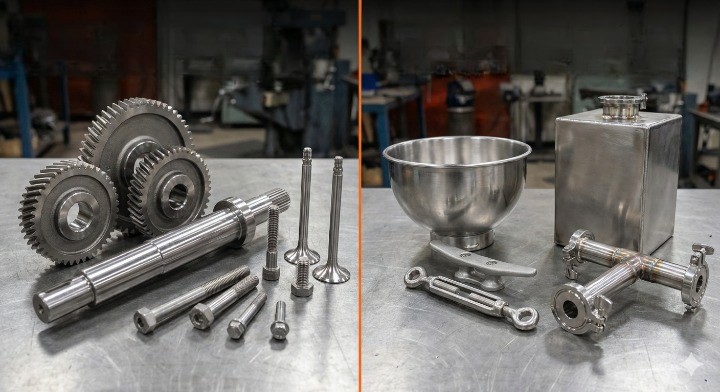
17-4PH is a better fit when strength and hardness matter most. 316 is the safer choice when corrosion resistance and easier fabrication are more important. The right material depends on how the part will be used, not just on price or availability.
Talk with HMaking
At HMaking, we help you compare stainless steel options based on your actual part requirements, machining needs, and budget. That means fewer material mistakes and a smoother sourcing process.
Contact us today for a quote. Send your drawings or CAD files, and we’ll help you choose the right grade.