


CMM inspection is the backbone of quality control for high-precision CNC machined parts. At HM, this article focuses on the CMM inspection process for CNC parts, explaining why it matters and how it supports reliable manufacturing outcomes.
As CNC components become more complex and tolerances tighter, traditional inspection methods often fail to detect geometric errors that affect assembly, sealing, and long-term performance. Many quality issues only surface after parts reach production or assembly, creating costly delays, rework, and disputes between buyers and suppliers.
Here, you will learn when CMM inspection is truly necessary, how it controls tolerance risk, and how to use CMM results to protect quality, cost, and delivery across CNC machining projects.
Why CMM Inspection Is Critical in CNC Machining?
CMM inspection is critical in CNC machining because it verifies complex dimensions and GD&T with traceable accuracy, supports functional assemblies, and detects issues long before they turn into scrap, rework, or customer returns. As part of a structured CNC machining quality control workflow, a well-planned CMM strategy turns inspection from a bottleneck into a control loop that stabilizes quality, cost, and lead time across prototype and production runs.
Controlling Tolerance Risk and Functional Fit
For many CNC projects, the real risk is not whether a single dimension is “in spec”, but whether the whole feature stack still delivers functional fit. Position, flatness, parallelism, and profile tolerances interact across multiple datums and operations. A caliper or micrometer can only see one slice of that picture at a time.
A coordinate measuring machine builds a full 3D model of the measured part, capturing many points on each surface and feature. It then compares this point cloud against the CAD model or drawing requirements, including GD&T callouts. With this approach, you can:
-
Quantify true positional error of holes and slots relative to functional datums.
-
Assess flatness and parallelism across entire faces, not just at a few points.
-
Evaluate profiles of surfaces that control sealing, motion, or optical performance.
When you use CMM inspection on critical CNC parts, you do not just confirm that “a few dimensions are OK”. You confirm that the part behaves correctly in the assembly, whether that is a robot joint, a gearbox housing, or a medical fixture. This directly reduces the risk of misalignment, vibration, leaks, premature wear, or noise issues in the final product.

From a process point of view, CMM data also gives you directional feedback. You see not only whether a dimension is out of tolerance, but in which direction and by how much. That makes it much easier for engineers and machinists to adjust tool offsets, clamping strategies, or cutting parameters instead of guessing. Over time, this feedback loop turns into a powerful tool to improve process capability (Cp, Cpk) and reduce variation.
Limits of Manual Inspection in Precision CNC Parts
Manual inspection tools still have their place. Calipers, micrometers, and height gauges are fast, inexpensive, and ideal for simple features and low-risk parts. The limitation is that manual methods struggle when tolerances are tight, features are complex, or inspection volume is high.
Several constraints show up quickly in real projects:
-
Limited coverage: operators typically measure a small subset of dimensions, often only those that are easy to reach.
-
Operator variation: differences in feel, alignment, and reading can introduce significant measurement error, especially on soft or thin-walled parts.
-
No robust link to GD&T: manual tools can give you linear sizes, but not a full evaluation of position, runout, or profile relative to a datum structure.
-
Low traceability: manual readings often end up as handwritten notes or simple spreadsheets, which makes trending and root cause analysis difficult.
As designs become more compact and multi-functional, you see more features packed into smaller volumes, often with mixed materials and multiple operations. In this context, relying purely on manual inspection is like checking a complex 3D assembly with a simple 2D drawing: you will miss something important.
By contrast, a CMM applies consistent probing forces, controlled motion, and calibrated scales. It can automatically execute the same measurement routine hundreds or thousands of times, with traceability to international metrology standards. This does not eliminate manual inspection, but it defines a clear split: use manual tools for simple checks, and reserve CMM for tolerance-critical or high-risk features.
Impact of CMM Inspection on Cost, Quality, and Delivery
At first glance, CMM inspection can look like a pure cost item. Machines are not cheap, programming takes time, and each CMM cycle consumes minutes of valuable capacity. However, if you look at the total cost of quality, the picture changes quickly.
Multiple studies show that the cost of poor quality in manufacturing can consume between 5% and 35% of total sales, driven by scrap, rework, sorting, line stops, and customer returns. Even a modest reduction in rework and escapes can easily offset the cost of robust CMM inspection. For example:
-
Catching a mislocated hole pattern in first article CMM inspection can prevent an entire batch from becoming scrap.
-
Using CMM trends to correct tool wear can extend stable production windows, reducing unplanned downtime and urgent adjustments.
-
Providing structured CMM reports to customers can reduce incoming inspection, disputes, and chargebacks on their side.
From a delivery perspective, unplanned rework and sorting are the true hidden enemies of lead time. A shop that ships parts “on time” but then faces high returns or nonconformances will suffer repeated schedule disruptions. CMM-based control helps stabilize the process earlier in the flow, so fewer lots need firefighting at the end. That translates into more predictable shipments and better on-time delivery performance.
There is also a strategic angle. When you choose a CNC supplier, you are not only buying machine time. You are buying their measurement capability and quality culture. A supplier with modern CMMs, ISO 10360–verified performance, and trained metrology staff shows that they take dimensional control seriously. That reduces your supplier risk and strengthens your own product reputation.
In short, CMM inspection is critical in CNC machining because it converts dimensional uncertainty into objective, traceable data, which in turn reduces tolerance risk, supports functional fit, and protects both cost and delivery performance over the full life of a project.
What Is CMM Inspection for CNC Machined Parts?
CMM inspection for CNC machined parts is a 3D measurement and verification process that uses a coordinate measuring machine to evaluate whether a part meets its dimensional and GD&T requirements. Instead of checking a few isolated dimensions, CMM inspection captures spatial data across multiple features and surfaces, then compares that data against the drawing or CAD model. This makes it especially valuable for precision CNC parts where geometry, alignment, and functional relationships matter as much as size.
In practical terms, CMM inspection provides objective, repeatable, and traceable measurement results. It connects design intent with manufacturing reality and allows engineers and buyers to confirm that parts will assemble, move, seal, or load as intended.
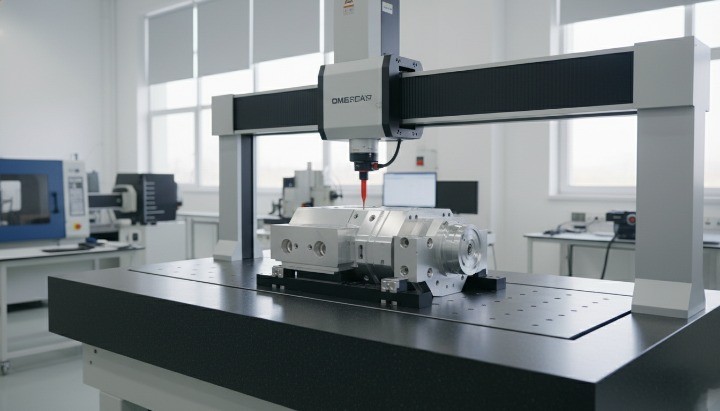
What Does CMM Stand for in Manufacturing?
CMM stands for Coordinate Measuring Machine. In manufacturing, it refers to a computer-controlled system that determines the exact coordinates of points on a part in a three-dimensional space, usually defined as X, Y, and Z axes.
A typical CMM system consists of:
-
A precision mechanical structure (bridge, gantry, or arm)
-
A probing system (touch-trigger or scanning probe)
-
Linear scales and motion control
-
Dedicated metrology software
The machine measures points on a part’s surface by physically touching it with a probe or by scanning it continuously. The software then calculates dimensions, form errors, and GD&T characteristics based on those points. According to ISO metrology standards, CMM accuracy and repeatability are verified through controlled calibration and environmental conditions, which ensures results are consistent and traceable.
For CNC machining, this matters because most parts are designed digitally. A CMM acts as the measurement-side counterpart to CNC machines, translating physical geometry back into digital data that engineers can analyze and trust.
CMM Inspection vs Traditional Dimensional Measurement
Traditional dimensional measurement relies on manual or semi-manual tools such as calipers, micrometers, height gauges, bore gauges, and optical comparators. These tools are effective for basic checks, but they operate under clear limitations when applied to modern CNC parts.
The fundamental difference is that manual measurement captures individual dimensions, while CMM inspection evaluates geometry as a system.
| Aspect | Traditional Measurement | CMM Inspection |
|---|---|---|
| Measurement scope | Single dimensions or features | Full 3D geometry and feature relationships |
| GD&T capability | Very limited | Full evaluation of position, profile, runout, form |
| Repeatability | Operator-dependent | Highly repeatable and software-controlled |
| Data output | Manual notes or simple records | Digital reports with traceability |
| Suitability | Simple parts, loose tolerances | Complex parts, tight tolerances |
Manual tools still play an important role on the shop floor. They are fast, flexible, and cost-effective for quick checks and simple features. However, once parts involve tight tolerances, multiple datums, angular relationships, or complex surfaces, manual tools struggle to provide reliable answers.
CMM inspection closes this gap by:
-
Measuring features relative to a defined datum system
-
Verifying functional relationships between features
-
Producing consistent results independent of operator skill
For CNC machined parts that must assemble accurately or perform under load, CMM inspection is not a luxury measurement method—it is a functional requirement. It allows engineering teams to move from “checking dimensions” to verifying performance-critical geometry, which is the real goal of quality control in precision manufacturing.
CMM Inspection Process for CNC Parts – Step by Step
A robust CMM inspection process for CNC parts follows a structured, repeatable sequence. You start from design intent, define how the part will be located, choose a measurement strategy, capture data, and finally turn that data into decisions. When each step is clear, CMM inspection becomes a predictable part of your quality workflow, not an occasional troubleshooting tool.

Step 1 – Reviewing Drawings, Tolerances, and GD&T
The first step is to understand what you need to prove, not what you can easily measure. That means starting with the engineering drawing and any defined GD&T according to standards such as ASME Y14.5 or ISO 1101. For CNC precision components, this review is essential to identify which features are truly critical for function, safety, and assembly, and which ones are secondary.
In this stage, you:
-
Highlight critical-to-quality (CTQ) features such as bore positions, sealing surfaces, and alignment faces.
-
Review tolerance types and levels, especially position, flatness, parallelism, and profile.
-
Clarify the datum scheme and how it relates to real assembly conditions.
This review is also the right moment to align engineering, quality, and production. If a tolerance is technically correct but practically unmeasurable, you adjust the plan before you cut material. That prevents arguments later and ensures the CMM program reflects actual design intent rather than guesswork.

Step 2 – Datum Definition and Part Setup
Once you understand what to measure, you must decide how to hold and locate the part. This is where datum definition and fixturing come in. A good datum strategy mirrors the way the part will be constrained in the final assembly, not just what is convenient on the CMM table.
In practice, you:
-
Select primary, secondary, and tertiary datums that reflect real mounting or alignment points.
-
Design or choose a fixture that supports the part without distortion.
-
Ensure repeatable seating and clamping so each part returns to the same location within the measurement volume.
A weak datum strategy can create systematic error. For example, if you locate on a rough or unstable surface instead of the true functional datum, you will see “variation” that is actually fixture-related. By contrast, a robust setup allows the CMM to build a stable coordinate system, so all subsequent measurements have meaning.

Step 3 – Probe Selection and Measurement Strategy
With the part located, you define how the CMM will touch or scan the geometry. Probe selection and measurement strategy directly influence accuracy, cycle time, and robustness.
Key decisions include:
-
Choosing between touch-trigger probes for discrete points and scanning probes for high-density data on profiles or freeform surfaces.
-
Selecting stylus length and tip size to reach deep features without excessive deflection.
-
Defining point patterns on each feature to capture form and orientation, not just size.
You also decide on the measurement sequence. Typically, you measure datums first, then work through critical features in a logical order that respects dependencies. For example, you may measure a bearing bore after you verify the face that defines its axial location. A clear strategy reduces unnecessary movements and minimizes the risk of collisions, while still giving you enough points to make statistically reliable judgments.

Step 4 – Measurement Execution and Data Capture
After the program is defined, you move to actual measurement execution. The CMM follows the programmed path, touches or scans surfaces, and records point coordinates relative to the established datum system.
During execution, you:
-
Load the part according to the defined fixturing method.
-
Call up the correct program and verify probe calibration status.
-
Monitor the first run closely to confirm clearances and point coverage.
The machine then collects sets of 3D coordinates along each feature. The software converts these points into geometric elements such as circles, planes, cylinders, and profiles. At this phase, stability and environment matter. You want a controlled temperature and low vibration so the machine and the part stay within their specified conditions, which supports repeatable and traceable data.
Over time, you can automate much of this step. Parts can be queued, programs can be selected by QR code or part number, and operators can focus on loading and unloading while the CMM executes the routine consistently.

Step 5 – Data Evaluation and Inspection Output
The final step is to turn raw measurement data into clear decisions and usable documentation. The CMM software compares measured features with nominal geometry and specified tolerances, then reports the results in a structured format.
In this step, you:
-
Review key results such as size, position, flatness, and profile deviations.
-
Check pass/fail status for CTQ features and overall part disposition.
-
Analyze trends across multiple parts to detect drift or process shifts.
The output can range from a concise first article inspection (FAI) report for a new part number to ongoing sample inspection reports in production. The best practice is to keep reports traceable to part numbers, revision levels, and measurement conditions, so that future investigations have a solid data foundation.
You can also feed CMM data into statistical process control (SPC) systems. In that case, CMM inspection becomes more than a gatekeeper. It becomes an input to continuous improvement, helping you adjust CNC programs, tools, and fixtures before nonconformances reach the customer.

CMM Inspection Reports for CNC Machining Projects
CMM inspection reports are the final and most visible output of the entire inspection process. For CNC machining projects, these reports translate complex geometric measurements into clear pass/fail decisions that engineers, quality teams, and buyers can act on. A well-structured CMM report does more than confirm compliance. It builds confidence that the supplier understands the drawing intent, controls variation, and can support stable production over time.

Key Elements of a Professional CMM Report
A professional CMM inspection report follows a logical, traceable structure. It allows anyone reviewing the document to quickly understand what was measured, how it was measured, and whether the results meet requirements. This clarity is essential when inspection data travels across companies, countries, and time zones.
At a minimum, a high-quality CMM report should include:
-
Part identification: part number, revision level, material, and drawing reference.
-
Inspection scope: whether the report covers FAI, sample inspection, or 100% inspection.
-
Datum reference framework: clearly defined primary, secondary, and tertiary datums.
-
Feature list: each measured dimension or GD&T callout mapped to the drawing.
-
Nominal, actual, and deviation values: shown numerically, not just pass/fail.
-
Tolerance limits and status: clear indication of in-tolerance or out-of-tolerance results.
Well-prepared reports also document measurement conditions, such as machine ID, probe configuration, and inspection date. This information supports traceability and is often required for audits or regulated industries.
For complex parts, many suppliers add color deviation maps or graphical representations. These visuals help engineers immediately see where deviations occur and whether they are random or directional. When used correctly, they accelerate root cause analysis and design feedback.

How to Interpret CMM Inspection Results?
Reading a CMM report correctly requires more than checking green or red boxes. The goal is to understand risk, trend, and functional impact, not just compliance on a single part.
When you review results, start with critical-to-quality features. Look at how close the actual values are to the tolerance limits. A feature that barely passes may still represent risk in production, especially if tool wear or thermal effects are expected. Results consistently biased toward one side of the tolerance band often signal fixture or process alignment issues, not random variation.
Next, review GD&T results carefully. For position, profile, or flatness, focus on how the feature behaves relative to its datums. Even when linear sizes look fine, positional errors can cause assembly problems. CMM reports make these relationships visible in a way manual inspection cannot.
Trend information becomes especially powerful when you compare multiple reports over time. By reviewing successive results, you can identify:
-
Gradual drift caused by tool wear.
-
Step changes linked to setup or fixture changes.
-
Stable processes with tight clustering well inside tolerance.
For buyers and quality engineers, this depth of interpretation matters. A supplier who can explain why results look the way they do is more valuable than one who only sends pass/fail data. Interpretation shows process understanding, not just measurement capability.
First Article Inspection (FAI) vs Production Inspection Reports
FAI reports and production inspection reports serve different but complementary purposes. Understanding this distinction helps you set the right expectations with CNC suppliers and avoid unnecessary inspection cost.
A First Article Inspection (FAI) report validates that a new part number or revision meets all drawing requirements. It is typically comprehensive and includes all dimensions and GD&T callouts. The goal is to confirm that the CNC process, tooling, and inspection method are fundamentally capable before volume production begins.
Production inspection reports, by contrast, are usually risk-based and selective. They focus on CTQ features and known risk areas rather than every single dimension. Sampling plans often follow standards such as ISO 2859 or internal quality agreements.
| Aspect | FAI Report | Production Inspection Report |
|---|---|---|
| Timing | New part or revision | Ongoing production |
| Coverage | Full drawing | Selected CTQ features |
| Purpose | Process validation | Process monitoring |
| Typical frequency | One-time or infrequent | Per lot or per schedule |
In practice, the strongest quality systems use both. FAI builds the foundation, while production reports maintain confidence over time. Together, they give engineers and buyers clear visibility into whether CNC parts continue to meet requirements as volumes increase and conditions change.
When you request CMM inspection data from a supplier, specify which type of report you need and why. Clear expectations reduce misunderstandings and ensure the inspection effort aligns with real quality and business objectives.
How CMM Inspects GD&T on CNC Parts?
CMM inspection plays a critical role in verifying GD&T requirements as functional controls, not just symbolic annotations on a drawing. While size tolerances confirm whether a feature meets nominal limits, GD&T defines how features relate to one another in real assemblies. A CMM evaluates these relationships in three-dimensional space, using the datum structure and tolerance zones defined by the design.

Measuring Position, Flatness, Parallelism, and Profile
GD&T characteristics describe geometry over surfaces and volumes, which makes them difficult or impossible to verify accurately with manual tools. A CMM overcomes this limitation by collecting multiple points and fitting them to mathematical models defined by international standards such as ASME Y14.5 and ISO 1101.
For position tolerances, the CMM measures the axis or center point of a feature, such as a hole or pin, relative to the datum reference frame. The software then evaluates whether that axis falls within the specified cylindrical or rectangular tolerance zone. This approach directly reflects how the feature will align during assembly.
For flatness, the CMM samples points across the entire surface and calculates the minimum distance between two parallel planes that enclose all measured points. This reveals surface warping that a straightedge or spot check could miss.
For parallelism, the CMM compares the orientation of one feature against a datum plane or axis. Even when thickness or height dimensions are in tolerance, parallelism errors can cause uneven loading, sealing failure, or accelerated wear.
For profile tolerances, the CMM shines. By scanning or probing multiple points along a contour, it verifies whether the entire surface stays within a defined tolerance band relative to the nominal CAD geometry. This is essential for complex housings, fluid paths, and ergonomic or aerodynamic shapes.
In all cases, the key advantage is completeness. The CMM evaluates the geometry as the standard intends, not as a simplified approximation.
Functional GD&T vs Over-Inspection
Not all GD&T callouts carry the same functional weight. Some control critical assembly interfaces, while others exist mainly for manufacturability or legacy reasons. A common mistake is to treat every GD&T symbol as equally important during inspection.
Functional GD&T focuses on features that directly affect:
-
Assembly alignment and stack-up.
-
Load transfer and motion accuracy.
-
Sealing, positioning, or interchangeability.
A well-designed CMM inspection plan prioritizes these features. It measures them with sufficient point density and frequency to manage risk. Less critical features may still be checked, but with simplified routines or reduced sampling.
Over-inspection creates hidden problems. It increases cycle time, clogs inspection capacity, and produces large volumes of data that add little value. More importantly, it can distract teams from real risks. Measuring everything does not mean controlling everything.
The most effective CMM strategies strike a balance. They verify GD&T where it matters for function and reliability, while avoiding unnecessary complexity. This balance usually comes from collaboration between design, manufacturing, and quality teams, not from measurement alone.
Common GD&T Interpretation Errors in CNC Inspection
Even with a CMM, GD&T inspection can fail when interpretation is flawed. These errors often stem from misunderstanding how standards define tolerances, not from equipment limitations.
One frequent issue is incorrect datum simulation. If the part is fixtured or aligned differently from the drawing’s datum scheme, the CMM may report false failures or false passes. The measurement is precise, but it does not reflect real assembly conditions.
Another common error is mixing size and location logic. Inspectors sometimes focus on size values while overlooking positional or profile deviations that are more critical. This leads to parts that “measure OK” but fail during assembly.
A third issue is using insufficient point density. Measuring too few points on a surface or feature can hide form errors. The result looks compliant, yet functional performance suffers.
Finally, teams sometimes apply default software settings without validation. CMM software is powerful, but it assumes the programmer understands how filters, fitting methods, and evaluation settings affect results. Blind reliance on defaults can distort conclusions.
Avoiding these errors requires more than a good machine. It requires GD&T literacy, disciplined inspection planning, and review of results with engineering intent in mind. When those elements come together, CMM inspection becomes a reliable guardian of functional quality rather than a source of confusion.
When to Use CMM Inspection in CNC Machining?
CMM inspection is most effective when it is applied strategically, not universally. The goal is not to measure every part in every situation, but to deploy CMM inspection where it delivers the highest risk reduction and decision value. In CNC machining, this typically happens at key stages of a product’s lifecycle and in applications where functional failure carries serious consequences.

Prototype Validation and Design Verification
The first and most critical use of CMM inspection is during prototype validation. At this stage, the objective is not efficiency, but confidence. For small batch CNC machining, CMM inspection helps confirm that the machining process can actually produce parts that match the design intent, especially when tolerances are tight or geometry is complex.
CMM inspection allows you to verify:
-
Whether GD&T callouts are achievable with the selected machining strategy.
-
How real geometry compares with the CAD model, not just nominal dimensions.
-
Where deviations occur and whether they are systematic or random.
For design and engineering teams, this data is invaluable. A CMM-based first article inspection can reveal that a tolerance is unnecessarily tight, or that a datum scheme does not reflect real assembly conditions. Catching these issues early avoids expensive design changes later, when tooling and volumes have already increased.
From a buyer’s perspective, requiring CMM inspection on prototypes is a risk-control measure. It ensures that the supplier understands the drawing, can interpret GD&T correctly, and has the inspection capability to support later production. Skipping this step often leads to costly surprises in pilot or ramp-up phases.
Batch Production and Process Capability Monitoring
In batch or series production, the role of CMM inspection shifts from validation to process monitoring. The question is no longer “Can we make this part?”, but “Are we still making it correctly and consistently?”
CMM inspection supports this phase by enabling:
-
Periodic verification of critical features instead of inspecting every dimension on every part.
-
Monitoring of positional and form tolerances that manual checks cannot reliably track.
-
Collection of consistent data for statistical process control (SPC).
By trending CMM results over time, you can detect tool wear, fixture drift, or thermal effects before they cause nonconforming parts. For example, a gradual shift in hole position might signal that a locating pin is wearing, even though size dimensions remain in tolerance.
Used correctly, CMM inspection reduces firefighting. It prevents late-stage sorting and rework that disrupt schedules and inflate cost. Stable CMM data supports stable deliveries, which is often more important to customers than marginal unit cost reductions.
High-Precision and Regulated Industry Applications
Some CNC machining applications demand CMM inspection as a baseline requirement, not an optional quality add-on. These include industries where tolerances are tight, assemblies are complex, or compliance is mandatory.
Typical examples include:
-
Robotics and automation, where alignment affects motion accuracy and repeatability.
-
Medical devices, where form and position directly impact safety and function.
-
Aerospace and defense, where traceability and GD&T compliance are strictly audited.
-
Automotive safety and powertrain components, where geometric errors can propagate across assemblies.
In these environments, customers often expect documented CMM inspection as part of qualification or PPAP-type submissions. Reports must be traceable, repeatable, and aligned with recognized standards. Manual inspection alone is rarely sufficient to meet these expectations.
Even outside formally regulated sectors, similar logic applies whenever a CNC part plays a mission-critical role. If failure leads to downtime, recalls, or safety risks, the cost of CMM inspection is usually small compared with the cost of failure.
In practice, the best results come from aligning CMM inspection intensity with application risk. Prototype parts, high-precision features, and regulated components deserve deeper inspection. Lower-risk parts can rely more on simplified checks. This balanced approach keeps quality high without turning inspection into an unnecessary burden.
Types of CMM Machines Used for CNC Parts
Different CNC parts require different CMM machine configurations. The choice is not about owning “the most advanced” system, but about matching measurement volume, accuracy, and accessibility to real part geometry and tolerance requirements. Understanding the main CMM types helps buyers and engineers judge whether a supplier’s inspection capability truly fits their parts.

Bridge, Gantry, and Horizontal Arm CMMs
Bridge CMMs are the most common machines found in CNC machining shops. They feature a rigid bridge structure moving over a granite table and offer an excellent balance between accuracy, footprint, and cost. Bridge CMMs are well suited for small to medium CNC parts such as housings, brackets, plates, shafts, and precision components.
Their strengths include high stiffness, stable thermal behavior, and strong repeatability. For most CNC machined aluminum, steel, and stainless-steel parts, a bridge CMM delivers more than enough accuracy for tight tolerances and GD&T verification.
Gantry CMMs are designed for large and heavy CNC parts. Instead of moving a bridge over a fixed table, the gantry structure travels over the part, which often sits directly on the floor or a large fixture. This configuration supports very large measurement volumes while maintaining reasonable accuracy.
Gantry CMMs are common in industries such as aerospace, energy, and heavy machinery, where parts are simply too big for bridge systems. The trade-off is higher cost, larger space requirements, and more demanding environmental control.
Horizontal arm CMMs use one or two horizontal arms extending from vertical columns. These machines excel at accessing large parts with complex features, such as automotive body components, frames, and welded structures. Their open structure allows fast access and flexibility, especially when checking many features spread over a wide area.
However, horizontal arm CMMs generally offer lower accuracy than bridge or gantry systems. For CNC machined parts requiring tight tolerances and precise GD&T, they are typically used for form, position, and overall geometry checks rather than ultra-tight measurements.
Each type serves a clear role. A supplier with the “right” CMM type for your part geometry is often more valuable than one with a mismatched but more expensive machine.
Measurement Range, Accuracy, and Part Size Considerations
When evaluating CMM capability for CNC parts, measurement range and accuracy must be considered together. A machine can measure a part only if the entire geometry fits comfortably within its working volume, including probe movement and clearance for fixturing.
Accuracy is usually specified as maximum permissible error (MPE) under standards such as ISO 10360. This value depends on machine size, structure, and calibration status. In general, larger machines have larger measurement uncertainty, even when they are well designed and maintained.
For practical decision-making:
-
Small, high-precision CNC parts benefit from compact bridge CMMs with higher intrinsic accuracy.
-
Medium-sized parts with mixed tolerances often fit best on standard bridge CMMs with flexible probing options.
-
Very large CNC components require gantry or horizontal arm CMMs, even if absolute accuracy is slightly lower.
Part size also affects probing strategy. Deep bores, internal features, or undercuts may require long stylus assemblies, which reduce stiffness and measurement certainty. A capable CMM setup balances reach with rigidity and compensates through proper probe qualification and program design.
Limitations of CMM Inspection and Practical Solutions
CMM inspection is powerful, but it is not a magic solution for every measurement problem. It comes with its own constraints in cost, time, setup, and environment. The most effective teams recognize these limitations and design practical strategies around them rather than treating CMMs as universal answers. When you understand where CMM inspection struggles, you can combine it intelligently with other methods to build a robust, efficient quality system.

Cost and Inspection Time Constraints
CMMs are a significant investment. Purchase, calibration, maintenance, and operator training all add to the cost base. On top of that, each part measured consumes valuable machine time. If every dimension on every part goes through the CMM, inspection quickly becomes a bottleneck rather than a safeguard.
The time impact is especially visible when:
-
Programs are overly complex and not optimized for cycle time.
-
Teams insist on full-dimensional checks in production instead of risk-based sampling.
-
Changeovers between part numbers are frequent and poorly standardized.
There are practical solutions:
-
Prioritize CTQ features and GD&T controls instead of measuring every dimension.
-
Use CMM inspection heavily in FAI and process validation, then switch to targeted sampling in stable production.
-
Standardize programming practices and reuse modular routines where possible.
By focusing CMM use on high-risk and high-impact dimensions, you reduce cycle time and cost while keeping real quality risk under control. CMMs deliver the most value when they are used as precision tools, not as generic checkers for everything.
Fixturing, Environment, and Operator Influence
CMM performance depends on more than machine specifications. Fixturing quality, environmental stability, and operator practice can make or break the credibility of measurement results.
Fixturing problems show up as:
-
Parts flexing or distorting under clamping.
-
Inconsistent seating that shifts the datum structure between parts.
-
Excessive overhangs that amplify vibration or stylus deflection.
Environmental issues include temperature variation, drafts, and vibration. CMMs are usually installed in controlled rooms for good reasons. Even small temperature swings can cause significant expansion or contraction on large metal parts, adding uncertainty to measurements.
Operator influence is less obvious than in manual measurement, but it still exists. Poor probing strategies, incorrect datum selection, or misuse of software filters can all distort results, even if the machine itself is in perfect condition.
Practical solutions focus on control and discipline:
-
Design robust, repeatable fixtures that emulate real assembly constraints without deforming the part.
-
Maintain stable environmental conditions within the range recommended by the CMM manufacturer.
-
Train programmers and operators not just on software usage, but on GD&T interpretation and metrology principles.
When these elements are in place, the CMM can deliver reliable, traceable data that engineers and customers can trust. Without them, even a high-end machine may produce misleading results.
CMM vs In-Process and On-Machine Inspection
CMM inspection is usually an off-line, post-process activity. Parts leave the machine, cool, travel to the metrology area, and wait for inspection. This sequence provides accuracy and traceability, but it also introduces delays. For some CNC operations, waiting for CMM feedback is too slow to prevent scrap or rework.
In-process and on-machine inspection approaches address this gap. Examples include:
-
Probing routines inside CNC machines to verify key dimensions before unclamping.
-
On-machine measurement to adjust tool offsets live.
-
Dedicated in-line gauges for high-volume, repetitive checks.
These methods offer faster feedback at the cost of some measurement uncertainty compared to a dedicated CMM. However, they are often accurate enough for process control during machining, while the CMM remains the reference tool for final verification and complex GD&T checks.
A balanced strategy looks like this:
-
Use on-machine probing to catch gross errors early and stabilize cutting conditions.
-
Deploy CMM inspection for functional and GD&T-critical features, particularly on first articles and periodic audits.
-
Reserve simple manual checks for low-risk dimensions and quick go/no-go decisions.
In other words, CMM inspection should be part of a layered measurement strategy, not the only layer. When you align CMM, in-process, and manual inspection around their strengths, you reduce overall risk, shorten feedback loops, and keep quality costs under control.
How to Evaluate a CNC Machining Supplier’s CMM Capability?
Evaluating a CNC machining supplier’s CMM capability goes far beyond asking, “Do you have a CMM?” The real question is whether the supplier can consistently generate reliable, traceable measurement data that supports your tolerance, GD&T, and risk requirements. Within a well-integrated manufacturing system, a strong CMM capability reduces supplier risk, shortens problem-solving cycles, and protects your product’s functional performance over time.

Equipment Accuracy and Calibration Standards
The foundation of any CMM capability is equipment accuracy. However, accuracy claims only matter when they are verified, documented, and maintained under recognized standards—especially when inspecting micro precision parts with extremely tight tolerances. Serious suppliers can clearly explain how accurate their CMMs are and how that accuracy is proven.
Start by asking about the measurement uncertainty and calibration method. Professional CNC suppliers calibrate their CMMs according to ISO 10360 or equivalent international standards. These tests verify volumetric accuracy, probing performance, and repeatability under controlled conditions. A supplier should be able to provide recent calibration records and identify the accredited body that performed the verification.
Also consider whether the machine size matches your part size and tolerance level. Measuring a small, tight-tolerance part on an oversized machine can introduce unnecessary uncertainty. Likewise, pushing a small CMM to its volumetric limits on a large part increases risk. The best suppliers match CMM size and configuration to the work they quote, rather than relying on one generic solution.
Environmental control is another key factor. Temperature stability, vibration isolation, and clean conditions are not optional details. They are part of the measurement system. A supplier who invests in a controlled metrology environment signals that inspection accuracy is taken seriously, not treated as an afterthought.
CMM Programming and GD&T Expertise
A CMM is only as effective as the people who program and use it. Strong suppliers demonstrate deep GD&T understanding and disciplined inspection planning, not just software familiarity.
Ask how inspection programs are created. A capable supplier starts from the drawing, identifies CTQ features, defines datums correctly, and then builds a measurement strategy that reflects functional requirements. They understand how probing patterns, point density, and fitting methods affect results. This expertise shows up quickly when discussing complex tolerances such as position, profile, or composite GD&T controls.
You should also assess how well the supplier can explain their inspection logic. When a quality engineer can clearly describe why a feature is measured a certain way, or how a datum structure reflects real assembly conditions, that indicates maturity. By contrast, vague answers or reliance on default software settings are warning signs.
Finally, look for evidence of learning and feedback. Suppliers with strong CMM capability use inspection results to improve machining processes. They do not treat CMM reports as static documents, but as tools for reducing variation and preventing repeat issues.
Documentation, Traceability, and Audit Readiness
The true value of CMM inspection often appears months or years later, when questions arise. At that point, documentation and traceability become critical. A supplier with solid CMM capability can reconstruct what was measured, how it was measured, and under what conditions.
Key indicators include:
-
Clear linkage between CMM reports, part numbers, drawing revisions, and inspection dates.
-
Defined retention policies for inspection data and programs.
-
Consistent report formats that allow easy comparison over time.
Audit readiness is especially important for regulated or high-risk applications. Even if your current project does not require formal audits, a supplier who can support them demonstrates discipline and transparency. They can quickly show calibration records, training documentation, and historical inspection data without scrambling.
From a buyer’s perspective, documentation quality often correlates with overall process control. Suppliers who keep clean, traceable CMM records are more likely to manage machining, tooling, and change control with the same rigor.
In summary, evaluating a CNC supplier’s CMM capability means looking at equipment, expertise, and evidence together. Machines provide potential, people provide interpretation, and documentation provides trust. When all three are strong, CMM inspection becomes a reliable pillar of your supply chain rather than a source of uncertainty.
This section addresses the most common questions engineers and buyers ask when defining inspection requirements for CNC machined parts. Clear answers here help avoid over-inspection, misaligned expectations, and unnecessary cost during sourcing and production.
What tolerance levels require CMM inspection?
There is no single tolerance value that automatically mandates CMM inspection, but in practice, CMMs become necessary when tolerance type and functional risk exceed the capability of manual measurement.
CMM inspection is typically required when parts involve:
-
Tight linear tolerances, commonly below ±0.02 mm, especially across multiple features.
-
GD&T controls such as position, profile, flatness, parallelism, concentricity, or runout.
-
Multi-datum relationships where feature interaction matters more than size alone.
Even looser tolerances may still require CMM inspection if the part’s function depends on geometric relationships. For example, hole position tolerances in an alignment-critical housing often matter more than diameter size. The key trigger is functional risk, not a single numeric tolerance.
Is 100% CMM inspection necessary?
In most CNC machining projects, 100% CMM inspection is not necessary and often counterproductive. Full inspection increases cost and cycle time without always reducing real risk.
A smarter approach is risk-based inspection:
-
Use comprehensive CMM inspection for first article validation and process qualification.
-
Apply targeted CMM sampling during production, focusing on CTQ features.
-
Combine CMM with in-process probing and manual checks for lower-risk dimensions.
100% CMM inspection may be justified for very low-volume, high-risk parts or regulated applications, but it should be the exception. Stable processes are controlled through capability and trend data, not by measuring every part.
Does CMM inspection affect lead time?
CMM inspection does add time, but its impact on lead time depends on how it is planned. Poorly integrated inspection can delay shipments. Well-planned inspection often prevents much longer delays caused by rework, sorting, or customer rejection.
Best practices to manage lead time include:
-
Running CMM inspection in parallel with machining whenever possible.
-
Prioritizing critical features to reduce measurement cycle time.
-
Standardizing programs and fixtures to minimize setup delays.
In many cases, CMM inspection shortens overall project timelines by catching issues early and avoiding downstream disruptions. The small upfront time investment pays back through smoother deliveries and fewer surprises.
Conclusion
CMM inspection plays a central role in modern CNC machining because it transforms dimensional uncertainty into objective, traceable data. When used correctly, it verifies GD&T as functional requirements, supports stable production, and reduces the hidden costs of scrap, rework, and assembly failure. It is not about measuring more, but about measuring what truly matters.
For buyers and engineers, the takeaway is clear: apply CMM inspection strategically, evaluate suppliers on capability rather than claims, and align inspection depth with real risk. If you are planning a project that involves tight tolerances, complex GD&T, or regulated requirements, you can contact us for a quote to review your drawings, inspection needs, and quality expectations before production begins.