


Bead blasting roughens a machined surface in a controlled way so matte light diffusion and coating adhesion improve. Many teams know it looks good, yet they struggle to predict roughness, cost, and inspection needs across a global supply chain. This guide explains how bead blasting works, how it differs from sandblasting, what to include in an RFQ, and how HM integrates the finish with CNC machining, die casting, and anodizing so engineers and buyers stay in control.
What Bead Blasting Does to a Machined Surface?
Bead blasting propels spherical or near-spherical media to micro-peen the surface, creating uniform dimples that scatter light and hide machining marks. It is best used when you want a consistent satin look without gouging the base metal.
The process relies on compressed air that accelerates media through a nozzle. Glass bead is common for aluminum because it plastically deforms peaks without cutting them. Ceramic or steel shot deliver higher energy for hardened steels. Key variables include air pressure, standoff distance, nozzle angle, cabinet humidity, and media cleanliness. Small adjustments alter how fast you hit the target Ra and whether the surface remains closed or starts to feel chalky.
Typical Ra for glass bead on 6061-T6 lands between 1.5 and 3.5 μm (60–140 μin) when measured per or . The process can either be a final cosmetic step or part of a stacked finish route. For example, blasting before evens out toolmarks so the dye absorbs uniformly. When bead blasting precedes painting, keep Ra near the lower bound so paint film build remains even.
Because media impacts every exposed area, masking determines what survives dimensionally. Precision bores, sealed threads, and datum pads should be taped or plugged before blasting. After blasting, an air knife and ultrasonic rinse remove trapped media so downstream assembly is clean.
Bead Blasting vs. Sandblasting — Picking the Right Media Energy
Bead blasting uses rounded media that peen metal gently, while sandblasting typically uses angular grit that cuts deeper. Choose bead blasting when you need cosmetic consistency; pick sandblasting when you must remove heavy scale or create a more pronounced anchor profile.
Impact Energy & Finish: Glass beads create satin to matte textures without sharply eroding edges. Sandblasting with aluminum oxide or garnet leaves sharper valleys suitable for powder coating adhesion on welded fabrications.
Material Compatibility: Aluminum, brass, and plastics tolerate bead blasting because media hardness is moderate. Sandblasting may smear aluminum or embed grit unless you specify softer media or lower pressure. Stainless steels and cast irons can handle either method.
Safety & Cleanliness: Bead media does not fracture into harmful dust as aggressively as silica sand, yet you still need sealed cabinets and media reclamation. Sandblasting open-air structures generates more debris and demands stricter PPE, respirators, and containment per . If your facility needs cleanroom-ready finishes, bead blasting in a closed cabinet with HEPA filtration keeps particulate off sensitive .
Environmental Controls: Because bead media lasts longer, waste generation is lower when you track cycle counts and change media before it rounds off completely. Sandblasting uses faster-wearing grit, raising disposal volumes and requiring clearer labeling for spent abrasive.
Equipment, Media, and Process Parameters That Matter
Equipment sizing, media choice, and nozzle settings dictate every quality and cost outcome. A poorly matched cabinet can double cycle time or leave tiger stripes.
Cabinet Size and Automation: Bench cabinets work for palm-sized components, but large housings need walk-in rooms or tumble blasters. Automation (robotic nozzles, turntables, or rotary baskets) stabilizes dwell time and reduces labor, yet it limits how aggressively you can mask complex parts. HM keeps both manual gun booths and programmable rotary cabinets to match lot size and geometry so you can specify the process that fits the drawing.
Media Selection:
-
Glass bead: Standard for aluminum and stainless cosmetic parts; available in mesh sizes 40–325.
-
Ceramic bead: Harder, resists fracture, ideal for titanium or high-nickel alloys needing consistent Ra after hundreds of cycles.
-
Steel shot: Adds compressive stress for fatigue-critical steels but can contaminate aluminum.
-
Plastic media: Protects plastics or thin aluminum skins when you only need light luster reduction.
-
Mixed media: Combining glass and aluminum oxide increases cutting power while keeping a satin look; require detailed reclaim procedures to avoid segregation.
Pressure and Nozzle Angle: Lower pressures (20–35 psi) protect thin ribs, while 45–60 psi handles structural elements. Shallow angles (30–45°) glide along surfaces, whereas 90° impingement removes burrs fastest but risks dimpling edges. Document a range rather than a single value to let technicians adjust for media age.
Consumable Controls: Track media cycles, humidity, and sieve cleanliness. Damp beads clump, causing striping. Monitoring cabinet differential pressure alerts you before dust collectors clog and start blowing fines back onto the part.

Design-for-Manufacturing Checklist Before You Specify Bead Blasting
The cheapest time to control surface results is during CAD and GD&T planning. Engineers should call out masking, Ra range, and inspection method at the same time they dimension holes and threads.
Tool Access, Masking, Threads: Avoid blind pockets narrower than 6 mm if you expect uniform blasting. Where pockets are unavoidable, add reliefs or plan for angled nozzles plus extra labor. Use silicone plugs for threaded holes and specify whether threads must remain Class 3 or can relax to Class 2 after finishing. For bearing bores, combine rigid caps with light adhesive tape so grit cannot migrate.
Thin Walls, Ribs, and Deep Pockets: Anything under 1.5 mm thick can deflect under 50+ psi. Provide temporary support ribs or request a lower-pressure pass plus intermediate stress relief. For die castings with thin ribs, consider blasting before final machining so you can re-cut datum pads afterward.
Witness Coupons and Boundary Samples: Include a coupon machined from the same alloy and run it alongside production parts. Agree on acceptable/overblasted samples, label them, and keep them for both parties. Coupons simplify profilometer readings because they lie flat.
Stacked Processes: If you need both blasting and , state the order.
| Design factor | Risk if ignored | HM recommendation |
|---|---|---|
| Masking map for bores/threads | Media embedment leads to scrap or extra re-machining | Provide CAD screenshots or color layers plus plug/tape bill of materials. |
| Minimum wall thickness | Warping or denting when pressure exceeds section strength | Keep thin walls above 1.5 mm or specify pressure ≤35 psi with support ribs. |
| Pocket access depth | Uneven texture and rework to blend stripes | Add approach channels or specify secondary manual pass with angled nozzle. |
| Post-blast cleaning | Media residue causes coating defects or contamination | Call out ultrasonic rinse + filtered air knife before packing. |
Bead blasting after anodizing will destroy the film; blasting before type III anodizing may slightly round edges, affecting fit-up.
Static & Contamination Risks: Electronics housings often need ESD-safe packaging post-blast. Use ionized air rinses and lint-free gloves so glass fragments do not cling to insulating plastics. Mixed-material assemblies (aluminum with steel inserts) require shielding to avoid galvanic contamination from stray steel shot.
What to Tell Your Supplier Upfront?
Comprehensive RFQs prevent restarts and make pricing accurate. HM recommends sending the following checklist with every bead blast request:
-
Part drawings with clearly marked surfaces to blast and surfaces to mask (use color layers or leader notes).
-
Media type + size (e.g., glass bead 100–170 mesh), acceptable substitutes, and whether virgin media is required.
-
Air pressure range, nozzle angle range, and target Ra span (example: 25–45 μin measured per ASME B46.1 along datum A direction).
-
Masking instructions, plugs, or fixtures supplied by buyer.
-
Cleaning expectations: ultrasonic wash, ionized air, or vacuum.
-
Inspection plan: profilometer model, stylus radius, sampling frequency, boundary sample references.
-
Packaging: poly bag with desiccant, anti-static foam, VCI paper, or cleanroom double bag.
Cost Drivers to Highlight:
-
Setups: Every time the part is flipped or re-masked adds labor; minimize surfaces that need partial coverage.
-
Media Consumption: Coarse media wears out faster; specify recycling expectations if you want to pay only for virgin charges.
-
Cabinet Throughput: Large panels block entire booths; quoting per square meter may be more accurate than per part.
-
Cleaning & QA: Post-blast washing, drying, and inspection can equal blasting time; indicate if standard ISO 9001 documentation like control plans or PPAP levels apply.
When we quote, we align the blasting cell with your lot size. Prototype lots often use manual guns plus boundary samples, while repeat orders leverage fixtures and check gauges so we can standardize cycle time.
Quality Assurance and Inspection Flow
Quality plans should state how often you measure Ra, who signs off on surface appearance, and what happens when readings drift. Treat bead blasting like any other critical-to-quality operation rather than a cosmetic afterthought.
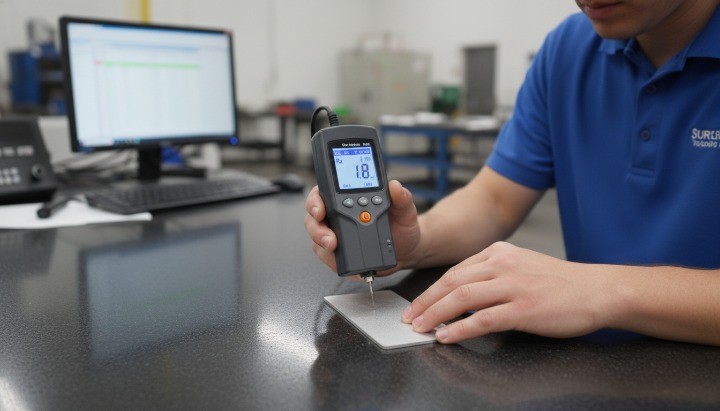
Profilometers & Visual Comparators: Portable stylus profilometers with 2 μm tips read Ra quickly when you align trace direction with major surfaces. Visual comparators (peened surface chips referencing ASME B46.1) help auditors cross-check appearance. Record both values to catch cases where Ra is fine but pattern is blotchy.
Sampling Plans: For small batches, measure every part at two locations. For mass production, adopt an AQL-based plan (for instance, 1.0 AQL general level II). Integrate bead blast data into your log so trends show up before customers do.
Process Control: Track cabinet pressure, nozzle wear, and media pH if you rinse beads. When readings drift, stop and refresh media before spec spread widens. Use SPC charts on Ra results; if two consecutive points hit warning limits, trigger maintenance.
Documentation: Combine bead blasting travelers with CNC machining routers so operators know which surfaces are critical. For programs that proceed to anodizing or painting, note surface prep verification to maintain traceability through final finishing.
Applications and Case Patterns HM Sees Most Often
Electronics Housings: Consumer and industrial electronics housings often need low glare so logos and labels are legible under harsh lights. Bead blasting hides toolmarks before clear or black anodizing, preventing color bands. Internal ribs that carry heat sinks must be masked to preserve flatness for TIM pads.
Automotive and Industrial Alloys: Shift knobs, actuator covers, and sensor housings use bead blasting to unify mixed machining and die casting textures. Steels benefit from steel shot for compressive stress, while cast aluminum uses glass or ceramic for gentle smoothing. For under-hood parts, specify sealing after blasting to keep salt out of pores.
Medical & Robotics Components: Handles and control knobs use bead blasting for grip. Document cleaning more tightly (validated detergents, DI water rinse) to satisfy biocompatibility kits. Robotics parts often pair bead blasting with to avoid glare in machine vision cells.
Mixed Process Routes: HM frequently machines aluminum manifolds, bead blasts cosmetic surfaces, then masks bores before hard anodizing. Another pattern is die-cast housings that get bead blasted to erase parting line cleanups before powder coating. Each combination should have its own traveler so technicians know the order.
How HM Integrates Bead Blasting Into CNC and Die Casting Programs?
HM provides CNC machining, die casting, anodizing, and bead blasting under one roof, so you can control appearance and tolerances without juggling vendors. We review drawings jointly with machining and finishing engineers, then simulate masking and fixturing before the first blast.
Collaborative DFM Reviews: During kickoff we host a short design review covering tool access, masking, and inspection. We also propose fixture concepts so you know how we will clamp the part during blasting. For tight product launches, we build pilot lots that stress cabinet coverage at different pressures and share comparison photos plus Ra data so you can choose the look you prefer.
Scaling Playbooks: Once a finish is approved, we store boundary samples, nozzle settings, and photo logs in the job book. For recurring assemblies we build dedicated racks or soft jaws. This keeps cycle time steady and simplifies reorder pricing. When new materials join the program, we run compatibility trials to ensure no cross-contamination.
Conclusion
Bead blasting is most effective when you define media, masking, pressure, and inspection with the same rigor you apply to machining tolerances. Documenting Ra targets, coupons, and QA checkpoints keeps matte finishes repeatable while preserving dimensional accuracy.